Friday, May 7, 2021

Days of the Virus: 412

Last Friday, April 30th, I hung up with my last patient of the day and ran down the stairs from my home office to hug my daughter for the first time in almost 14 months (she had come for the first visit in nearly that long and was waiting until my session was over).  Even now, days later, it still brings tears to my eyes to think of how much I missed her.  

The day counter I embedded in one of my early posts about the pandemic read almost exactly 412:  I started it the hour of my last in-person patient, March 14, 2020 and I stopped it moments after that first hug with my daughter.  Four hundred twelve days:  days of hopefully expecting this thing to be over quickly, crushingly discovering that it would not, anxiously wondering how long it would last, impatiently waiting our turn for vaccines, and, now, being confusingly grateful for our safety and aghast at the horrors SARS-CoV-2 is still wreaking.  

The pandemic is not over, of course.  Countries' healthcare systems are still collapsing across the globe.  I know of two friends-of-friends killed by COVID-19 in just the last few weeks.  What has happened in my family's circumstances, though, is that we are all vaccinated and past our post-shot waiting period, so we can cautiously re-venture back into a world that we've become accustomed to fearing, and can no longer meaningfully call ourselves isolated, quarantined, or locked down.  I fear less both for myself and for what I might bring home to my family.  I still wear masks in public, but I can be in public.  I have to be mindful not to offer a friendly handshake when introducing myself to a stranger, but I do meet them.  It still is anxiety provoking to go anywhere outside my yard, but I remind myself that I can go -- and I do go, anxious or otherwise.  

The year 2020 was vicious not just because of COVID-19.  The Great Ambivalence my country continues to suffer was only exacerbated by the pandemic and the anger and frustration between Team Red and Team Blue escalated to new heights, ratcheting up the pain like a nationwide replay of Milgrim's obedience experiments.  Government dysfunction at the federal level aggravated problems with food and healthcare infrastructure, highlighting the divide between the Haves and Havenots, between Whites and People of Color, between the I-Got-Mines and Everyone Else and it scrambled the rollout of vaccines into a near free-for-all.  I think few of us are sad to see the backside of 2020.  

All of that makes the phrase "back to normal" a non-starter.  We still have the same racial issues and government paralysis we did a year ago, even if we can point to some evidence of change.  Whole sections of our economy have been profoundly undermined -- a walk through any downtown will tell you that.  These are the new normal.  But there is still a "back to" to get:  back to life, back to being with each other, back to what makes us human.  

So far, I've had at least one patient per day return to in-person sessions.  Each meeting, it feels simultaneously very strange and reassuringly familiar.  (Emphasis on the "strange" at first:  my first in-person session, I felt so anxious that I was seriously derealized for the first five or ten minutes!)  Yet every session reminds me that we are not alone, that this is not a computer simulation, that we are real people living real lives doing real things feeling real feelings.  And that seems about as close to "back to normal" as we need.  

Monday, March 29, 2021

Vionola/Rotola: More on the Pinblock and Experiments with the Soundboard

Before I pick up where I left off with this instrument, I need to revisit what to call it:  in going through some old notes, I saw that my initial idea for the name was "rotola" and I had somehow forgotten that.  Being reminded, I realized that this was a much better name, in part because the instrument has little or nothing to do with the violin and viol family of instruments and in part because rotating is a central (sic) part of what makes it what it is.  So, henceforth, rotola it will be.  

I ended my first post about this project at the point where I had succeeded at cutting and joining an eight-piece, radially-symmetrical pinblock.  Because the 3/4" Baltic birch ply from which the pinblock was cut was too thin to function reliably, I had to double it up, creating material ~1 1/2" thick.  This was good enough to work as a pinblock, but it was still not as thick as the radius of the resulting octagon, so there would be a hole in its center.  Thus: 


This caused a problem, in that the axle upon which the body would turn was quite a bit smaller radius than the opening left by the undersized BBP and so needed some bridging material between the two.  I settled on using some of the walnut I got for other parts of the instrument, as I was likely to have plenty extra.  

Initially, I decided a single plug would be a good solution, so I glued up a few square(ish) blocks:  


Then attempted to cut them octagonally: 


But didn't quite get my measurements right:


On further thought, though, I realized that this was probably not the best way to go anyway.  Making a solid block insert for the cavity would mean that the grain would be aligned to the axle such that the end grain of the block would interface with the long (side) grain of the axle.  This would likely make for a weak joint in a place where I needed as strong a joint as possible:  the contact between the insert and the axle would bear the brunt of the tension from the pull of the strings.  (Similarly, the contact between the insert and the pinblock would also end up being end grain to long grain, so there would be two potentially problematic joints.)  The soundboards are not meant to provide a great deal of support, if any; I imagine the instrument being able to support the strings under full tension without any soundboards on it (even though I would not build it that way).  

So, I took a new approach, building a radial plug such that the grain of the insert would be parallel with that of the axle.  (It would also be in the same plane as the grain of the pinblock, i.e., perpendicular to the radius.)  Although a bit fiddly, this was fairly straightforward, as I had already made the jig for cutting the BBP at the correct angle.  For reference, here is one set of my successful initial test cuts (left) next to a cut of walnut (right):


Once I had eight walnut wedges, the next step required hand fitting each individual piece into the center, as, inevitably, there were small variations in each of the bits that made up the pinblock:  


I was careful to keep track of which was which, as you can see.  

Once that was done, I glued it all up.  With so many gluing faces (three on each wedge), the glue itself added more than measurable thickness, so it was a pretty tight fit, but I was able to get it all together without blowing the original BBP ring apart!  


You can see that there remains a small hole; this was smaller than the diameter of the axle, so it didn't matter.  

Once I cleaned up the squeeze out and sanded the faces flat, I could see in my hand this thing I had only imagined before.  I began to realize that an octagon is really not very far from a circle after all and, further, that rounding it off would mean losing fewer layers of the pinblock than I had expected.  It occurred to me that it might actually be fairly easy to make the instrument cylindrical, as I had initially envisioned.  Thus:


Additionally, I could see that the pinblock was overall much larger and more robust than I had pictured in my mind, making room for more than one pin -- and therefore string -- than I had thought:


(This is a pic from before all the above happened, when I first started considering how much bigger the pinblock was than I expected.)  Looking at the pinblock from above, imagine these two pins going down into the block, rather than laying along it:  even with two, each pin has plenty of wood to anchor in, especially when you consider the pin density in the block of the bowed psaltery I made a few months ago, which is thinner and longitudinally about the same:


You can easily imagine the pinblock supporting twice, even three or four times the number of pins.  That's a question for later, as the issue mentioned above of a structure for supporting the string pressure would have to be resolved -- although I do have some ideas about how to do that.  

In any case, it seemed obvious, given how close it was already, that the rotola should be round.  It turned out that the void left by the walnut wedges was much more accurately in the center than I expected, so I began brainstorming for ways to take advantage of that, especially considering my limited tools.  In the end, though, I decided that my current tools and equipment were insufficient to produce the result I wanted with the accuracy I believed was needed, so I decided to splurge on a bench sander, something that I will use a lot in instrument building, anyway.  This was back in February, but it is still out of stock as of this writing; it seems I'm not the only one who decided to build or expand their woodshop during the pandemic.*

Once I realized that it was going to be a while before I could take the next steps with the pinblock, working on the soundboards became the obvious thing, but now with a new, literal, twist:  if the rotola was going to be round, the soundboard parts had to be sections of a cylinder, not just flat rectangles.  Again, after quite a bit of online research (it's ridiculous how much of this project would be impossible or nearly so without the Internet), I decided on a method for shaping the soundboards:  steam bending with molds.  I imagined two, 2' long, laterally curved (i.e., perpendicular to their long dimension) parts to the mold, one concave and one convex, the latter's radius being 4mm shorter -- the thickness of the spruce stock I had for the soundboards.  The mean radius needed to be a bit tighter than that for the pinblock, as steam-bent wood snaps back somewhat, so I made my estimates and got to work.  

As I've written elsewhere, I have been taking a very conservative approach to the pandemic and have left the house only a few times for pressing personal care needs (medical, etc.).  Thus, the materials I have available for this work are either special ordered -- and therefore inordinately expensive -- or scraps.  That, in turn, meant that the material I had for making these molds was the most twisty and knotty bits of leftover construction lumber from building my workshop last summer.  Producing stock that was thick, square, and straight enough to carve accurately took some (read: a lot of) work, but it was also useful practice for me, as I am very much a novice woodworker.  

Once I was able to build up some usable basic material, I cut the convex side of the mold first, as it was much simpler and easier a job, using techniques I've seen for carving guitar necks.  Unfortunately, I didn't take pix of this process; I just got caught up in the excitement of it, I guess.  However, at the end of this post you'll see it and how it works.  The concave side was going to take quite a bit more work, along with some new blades for my router.  The plan was to hog out as much as possible with a curved router bit, then use some finishing tools to get the final profile.  Overall, that's what I did, but I learned some significant lessons along the way.  

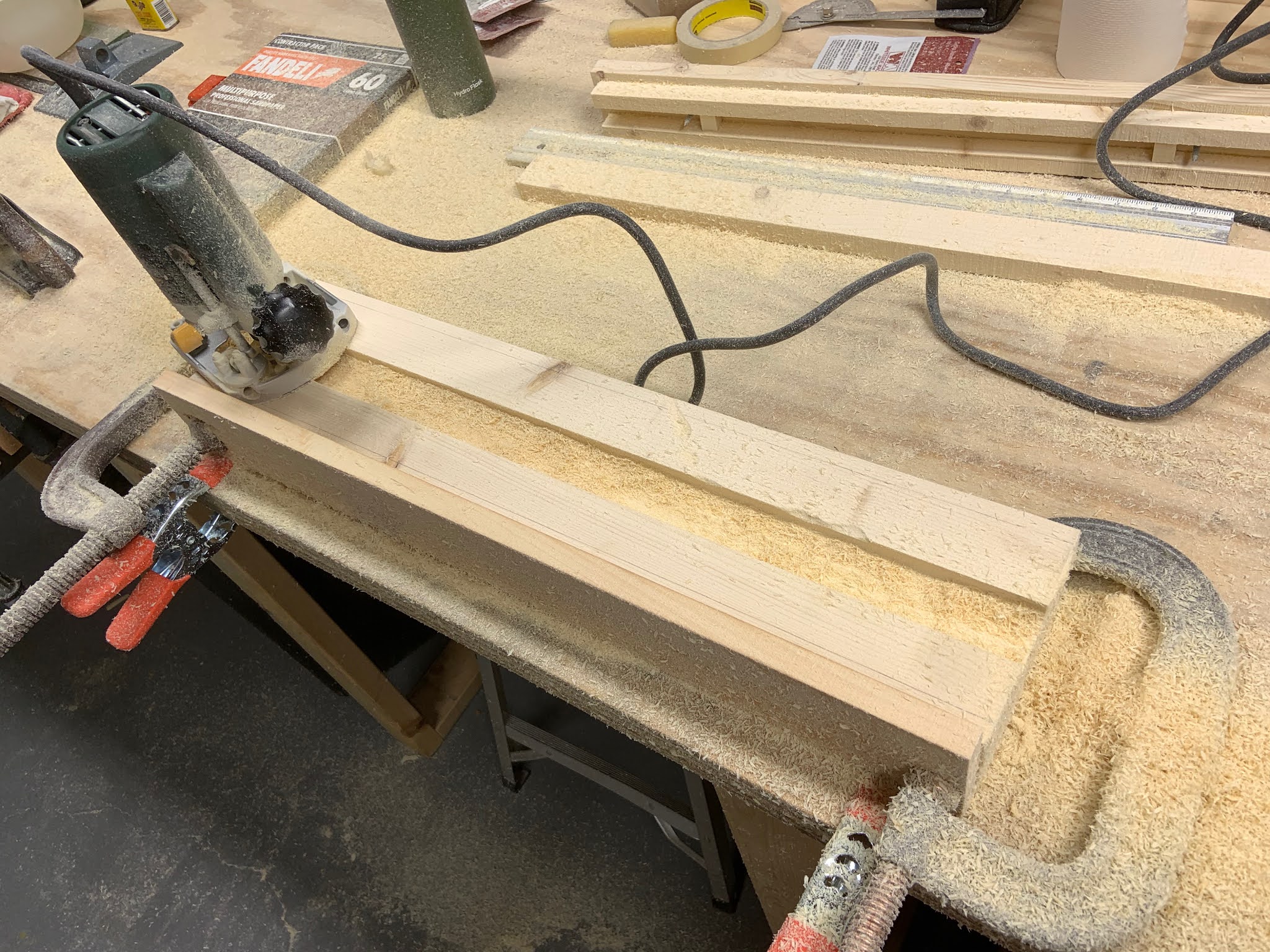
Here's the beginning of the routing:  


As you can see, it generated quite a bit of sawdust -- and this was just the first few passes!  Again, my novice status was dramatically betrayed by my amazement at how much yellow snow was generated by pulverizing just a few dozen cubic centimeters of wood.  My entire workbench was coated in variously thick layers of powdered tree, so, after this, I moved the project off the bench, which has far too many small things upon which dust can settle, and into the middle of the floor, where I could just shake myself off and sweep up.  (My next router will have dust collection.)  

Work progressed slowly but fairly steadily.  I needed to come up with a series of jigs for precisely guiding the router one of which you can see in the upper right of the first pic:  


Finally, I had gone about as far as I thought my ability to build accurate jigs would go:  


If you look closely at the last pic, you can see that my cuts are about half a millimeter west of the guide mark and that the top four cuts (two uppermost levels, right and left) are just a bit wide.  The latter turned out not to be a problem, as the convex side of the mold sits much lower than that in the concave mold and, more relevantly, the strips of spruce I'll be pressing are not wide enough to come up that high anyway.  The former wasn't a problem, either, as the overall cut was symmetrical and the correct radius; the misalignment was more a function of my guide mark being off center.  All that said, the mistakes were useful lessons.  

Hogging done, I now had to figure out a way to finish the arc.  Initially I thought I'd scrape it and spent a fair bit of time trying to get my new curved scrapers ready for first use.  I had not held a wood scraper in my hand for more than 35 years and had never prepped a new one myself; indeed, I'm not certain I was ever particularly good with them despite having a couple of mentors who swore by them.  As it turned out, however, (and as probably anyone who used scrapers effectively would have told me) even a well-sharpened scraper was not the tool for this:  there was simply too much material to remove yet and scrapers are for fine finishing.  

So, I returned to a method I've been using a lot:  coarse-grade sandpaper.  I cut a convex block to the same radius as my concave mold (remember, the convex mold has a radius 4mm shorter than the concave half), stuck some 60 grit to it with some tacky spray, and went to town.  (As I write this, it occurs to me that I should have accounted for the thickness of the sandpaper, as 60 grit is probably at least a millimeter thick, maybe more, and would thus increase the radius of the mold; that, in turn, would reduce the correction for the snap-back after the steamed wood dries.  More on that below.)  

This is what it looked like:    


In the last pic, you can see that I was having an especially hard time with the ends of the mold.  It turns out that the stock at each end had a cluster of small knots, making the wood harder to sand (and harder to do so evenly).  Further, regardless of the knots, the ends just didn't sand as quickly, as I was taking care not to round over the edges with the sanding block.  If you think about it, the ends only get like half the sanding that the middle gets, just by virtue of not getting full strokes.  In the end, it took a good hour or more of meditative work, but I ended up with a serviceable surface (unfortunately, I seem not to have taken a final shot of this).  

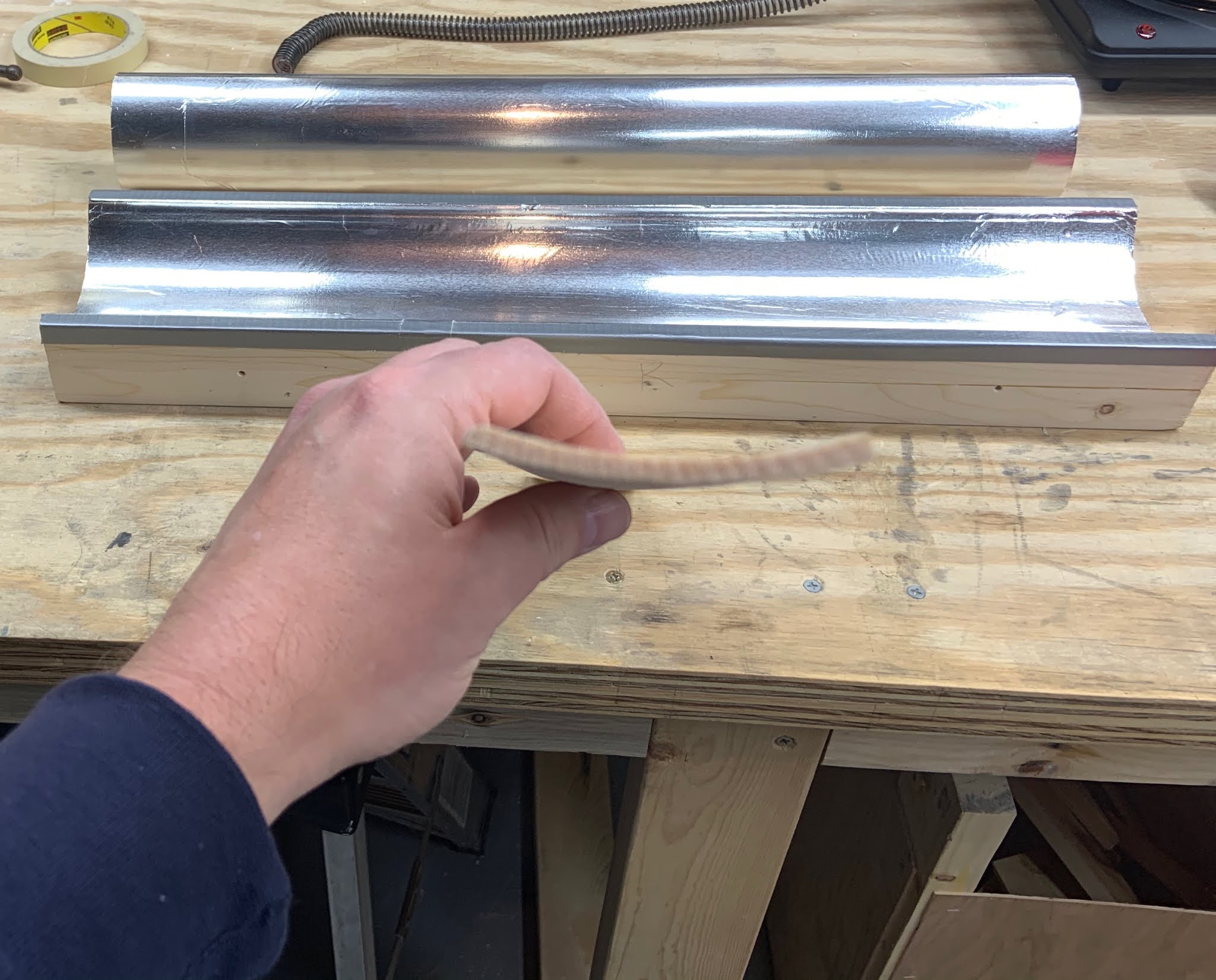
That done, I now had to figure out how I was going to seal the molds.  This was soft wood, really not much, if any, harder than the spruce I'd be using for the soundboards, so I needed to protect it from the steam.  I brainstormed several options, but opted for aluminum foil:  it didn't corrode and was water resistant, easy to use, and handy.  Lightly coating the molds with tacky spray, I applied the foil as carefully as I could and ended up with these:  


Next step, of course, was steaming!  I needed to test my setup, however, and didn't want to risk my actual soundboard material, so I used some of the offcuts from building up stock from the construction lumber; as it turns out, I had several bits that were roughly 4mm thick with close to quarter-sawn grain.  I planed one of these down and cut it to a similar size as what the soundboards would be.  I bought a hot plate (I plan on using hide glue on some projects, too, so this will be handy in several ways) and a cheap tea kettle.  I scrounged some hose from an old CPAP machine and, for the bag, used a poultry oven bag (it turned out, only the latter was heat-tolerant!).  Once set up, I tossed the test piece in the bag, sealed it all up with duct tape, and let it go:


I really had no sense of how long this should take, but I let it steam for a good 20 minutes or more.  I then quickly removed the wood and clamped it in the molds:  


It took a great deal of willpower to let this sit undisturbed for 24 hours, but I succeeded.  Unsurprisingly, given the molds' aluminum lining, the test strip was not dry when I opened it, but it did have a curve!  It also retained it once it dried, albeit predictably attenuated.  


(I didn't quite get the focus right on that last one, but you can see the result.)  

Overall, I'm very happy with this.  The next step will be to round off the pinblock, so I can get the exact radius I need for the soundboards.  It's reasonably likely that I will need to make new molds, but that should be easier than this was, not only because of my experience from this, but also I'll have a better router and will be able to go out and get new and better wood (spoiler:  my family is getting vaccinated!).  In the meantime, I'm going to do some non-musical-instrument related puttering in the workshop (re-setting up a plane, organizing, maybe making some tool  accessories) and also return to music-making (I have a couple of unfinished projects waiting).  I hope this has been interesting -- or at least entertaining -- and am excited about sharing the next steps with this build!

---------------

* Surprisingly, I couldn't find any research indicating an increase in demand for woodworking tools and materials during the pandemic, but participants in online forums seem pretty consistently to report increased prices on wood and outages and waitlists for tools across the board since COVID began.  Popular perception seems to be this is due to increased demand, but one article I saw suggested it was decreased production instead.  In either case, th'r'ain't much out there fer th'gittin'!

Sunday, March 14, 2021

Days of the Virus: A Year

Saturday, March 14th, 2020 was the last day I worked in my office and I mark it as the beginning of quarantine/isolation for my family and me.  My post that day outlined the personal events and those in the news that led to our decision to stay home and I commented at the time that, even considering those events, my reaction felt perhaps over the top.  A year later, in the wake of ugly scenarios predicted and unpredicted, it's clear that that was not so.  

The last few months have seen a more-or-less steady drip of reminders of the portents to lockdown:  a year from the first newscasts talking about "that terrible thing happening in China," from the first cases outside of China, then those in the US and wondering whether it would stay on the West Coast, then the first cases in New York City, by which point it seemed inevitable that it would show up here in Baltimore.  Still, the decision to lock ourselves at home happened faster than I (or most of us, I suspect) anticipated then:  I remember talking to patients beginning the week of March 9th about the chances that I would be converting to telepsych; by that Friday, I was telling them we would be locking down ASAP.  

I was talking with my daughter last week about this and she rattled off the COVID-19-related events that had happened for her that week:  warnings from her university that they might close campus, the announcement soon after that campus would in fact close, and the closing of the dorms.  A similar drumbeat was tapped out by my step-daughter's school and both girls decided that they could not see us for fear of exposing us.  Both ended up moving, the younger to her mother's, the elder to her boyfriend's.  This time last year, my family was, as so many others were, too, concurrently navigating relationships, housing, and unknown mortality risks while negotiating if and how we might ever see each other again.  

Our previously irregular but not infrequent family gatherings -- sometimes weekend dinners or brunches, sometimes impromptu evening hangouts -- at first just moved outdoors.  It was odd to keep six feet apart when we were used to draping ourselves across each other on the couch, to say nothing of hugging -- mine has always been a handsy clan, so "no contact" hit us especially hard -- but Mother's Day, Father's Day and Independence Day felt almost satisfying.  Just when it seemed like we were getting used to it, summer ended and the cold put the kibosh even on blanketed bonfire gatherings.  We had a few family videochats, the last one on Christmas, I think, until the imbalance of comfort with the technology across family generations made them prohibitively awkward.  We still talk by phone fairly frequently -- frequently enough, in the last few months, that we mostly don't notice how strange it is not to see each other's faces or hug or hold hands.  

Over the last year, I've found many of the broad themes in what I thought were my own struggles were actually being experienced by lots of us (at least among those with whom I share a socioeconomic stratum and who were privileged to be able to quarantine).  Initial panic and hunkering down, tearfully bidding a hopefully temporary good-bye to loved ones isolating, followed by a brief period of confidence that "we can get through this," followed, in turn, by the realization that the pandemic was going to last much longer and be greatly more challenging than initially thought, again followed by the simultaneous experiences of the slow drag on cognition and motivation combined with a smoldering anger at the intractableness of the situation, all sliding down into a fog of a new normal.  

In the early months, like a lot of folks, we put the money we saved on dining out and travel into household projects:  Jen started a raised bed vegetable garden and I started a workshop in the basement.  We settled into working from home, expanding Jen's previously insufficient workspace into a dedicated office and carting my big, comfy "therapy chair" from my office, up a very inconvenient staircase, and into my home music studio, which now functions far more often as a therapy room.  We canceled our gym membership and bought a rowing machine and treadmill (we don't use them as much as we did when we first bought them, but they do still get used!).  

We tried to keep ourselves entertained in other ways, too.  We're not a big sports household, but we enjoy baseball and Jen has followed college women's volleyball and men's basketball; some years I follow European cycling.  Mostly, we watch this on TV, although we try to get to a few games in person, but this year, of course, was all-TV; yet the normalcy and excitement all seemed lost by how pointless it felt without spectators (I can only imagine what it must be like for the athletes).  I suspect there are some media and sociological studies that will come from that.  

Television -- or, to be clearer, that seething morass of cable, streaming, and Internet audio-visual content that TV has evolved into -- has come to occupy a hugely greater fraction of my daily hours than it ever has or ever wanted it to.  I won't publicly admit exactly what that is, but most of my adult life I have prided myself in watching little to no "regular TV," like series, sitcoms, etc., with an average consumption well below published norms.  Just the other day, however, I was shocked to read that what I'm watching now is well within the current range for the average viewer.  I know why this is, of course:  the pandemic's pall of isolation saps one's energy, focus, creativity, motivation.  Although I have managed to keep creative during this time -- most of my output has ended up on this blog -- I just don't have the oomph I did a year ago.  Even reading has been affected; it's not just energy lost, but acuity and attention.  So, screen time has gone up.  Add to that videoconferencing (a typical workday is four to five hour-long sessions, occasionally six) and it's crazy how much time I spend looking at pixels.  

Everything has come to revolve around the house -- "the compound," as one friend called it.  There is a certain self-reinforcement of this kind of domestic navel-gazing, in which the more we focus on keeping ourselves fed and entertained at home, the less we think of the things we used to do outside of it.  Appointments that cannot be conducted via videochat simply aren't kept or made.  Errands that can't be converted to deliveries are not run.  The cars sit unused for weeks, even months.  Fewer and fewer things call us out of the house, so we look outside less and less.  Taking the trash to the curb has become my only regular outdoor excursion.  It's gotten to the point that, on an unseasonably warm day last week, I took the Miata out for a drive and was stunned to remember what the sky looked like!  (Really.)

Now, of course, with the vaccine, there is reason for hope.  The US is doing well among large industrial nations in getting its populace vaccinated, second only to the UK as of this writing.  Yet, even this complicates things:  sometimes it's hard to know which tier one qualifies for; leaders tell us to wait our turn and then we are told by the same government officials to get on every list we can; the US' vaccine distribution system makes our tax system look compulsively clean and organized; supplies appear and disappear like a vast game of Whack-a-Syringe.  It's confusing to see so many of my eligible friends (I know a lot of health care providers) getting vaccinated, yet the same resources they used tell me they're waiting on supply.  That said, currently, my mom is fully vaccinated and my wife has had her first shot, so there's still plenty to be grateful for.

More than that, change is in the air.  Spring has come after a long, painful winter.  Winters as such here in Baltimore aren't usually bad, but the season is just hard for my family; long, dark nights and gray days slow our minds and hearts like cold tar.  My wife has been finishing her master's degree, which has been very demanding, while growing her business at the same time, but she graduates in May.  The politics of the election, especially after November 8th, weighed on us like piles of x-ray vests, but our federal government is showing signs of function again.  I am beginning to take seriously my imaginings of returning to working from my office again -- perhaps in as little as six weeks, if I can get my first shot soon -- which would serve, as its cessation did at the beginning, to mark the end of quarantine for my household. 

So, a year on from its start, quarantine sees us still struggling -- exhausted, confused, worried -- but perhaps less so and definitely more optimistic, if a bit impatient.  Beneath our masks, we take a breath, poke a cautious nose out the front door, and consider the many things the world has to offer that we might soon, and once again, take in.  

Monday, March 8, 2021

Days of the Virus: The Cost of Individualism

Find the cost of freedom, buried in the ground,
Mother Earth will swallow you,
Lay your body down.

-- Stephen Stills, from "Find the Cost of Freedom" performed by Crosby, Stills, Nash & Young

As of this writing, there have been nearly 29 million cases of COVID-19 and more than half a million deaths attributed to it in the US alone, according to the Washington Post.  Google reports that, worldwide, 2.59 million have died and there have been 117 million cases.  Think about those numbers:  the US represents about 4% of the world population, yet we carry nearly a quarter of all cases and over a fifth of all deaths.  

Anyone paying attention to our country's response to the pandemic should be unsurprised by this.  Every other country with the means to protect itself has done so with a hunger and fear appropriate to the situation.  However, the United States covets its individualism to a degree that has led it deeply into the territory of denial and unnecessary death.  

This phenomenon is not new.  Our body politic organized itself on principles of self-determination.  We've fought wars over an extreme version of this, a perceived "right" to do as we please, regardless of the consequence to ourselves or others.  A quarter to a two-fifths of our population continues to value that "right" above all others.  It's no accident that we struggle with self-preservation that requires behaviors based on collective values.  

Our species evolved out of a tension between the individual and the collective.  Survival strategies based on strength in numbers and being as community are useful; they make attack on and defense against the community very difficult for individuals, which are easily overwhelmed.  Creating cohesive communities, however, tends to reduce variation across the individuals comprising the group, so a weakness in one individual is likely also to end up being replicated across the group, leaving the group vulnerable.  On the other hand, a certain amount of individual variation can counter this by supporting innovation, whether genetic or behavioral, within the group.  A group whose members are not all alike benefits from the varying strengths of its members while reducing the cost of the weaknesses, in a kind of tag-team effect.  That said, variation, in turn, reduces group cohesion; too great a variance within a community and that community falls apart.  Thus, the robustness of a collective is dependent upon a balance between empowering the strengths of the group and those of the individual.  

We, in the US, are far out of balance, as evidenced by our behavior and performance during the COVID-19 epidemic.  The culture of the United States is, according to solid research, the most individualistic (as opposed to collectivistic) in the world, and has been, I believe, since such measures began (around the 80s or early 90s).   Even in the face of an outrageous and unnecessary fraction of our people dying, we seem unable to change.  

Let us consider the cost of our so-called "freedom."

Saturday, February 20, 2021

Decem Annis

In the early hours of New Year's Day 2011, the thought having been nagging me for some weeks, I passed my insomnic hours while visiting in-laws by searching the Internet for a software-based synthesizer that I could afford and with capabilities that would mimic those of the modular synths I fantasized about owning in the 1970s.  I stumbled upon ZynAddSubFX, a powerful and free softsynth that I immediately downloaded and began messing about with.  After working with it for a few weeks, I found that I had written a piece of music that I actually liked, the first such thing I had done in probably 25 years, and I began giving thought to how I might share this new creative output.  It was out of that intention that I started this blog, 10 years ago today and have maintained it, if somewhat irregularly, since.  

I'm not sure how clearly I thought about where I would go with blogging or how sustained any efforts might be, but this rebooting of the earlier Circling Crows blog coincided with a series of significant shifts in my life in which I came increasingly to trust myself and my own judgement and to recognize, validate, and address my own needs.  Much of my life I'd spent second guessing or subordinating myself to others, particularly those closest to me.  Letting music out of me in early '11 -- indeed, fighting to make room for music in my life -- was a powerful concrete step in breaking that pattern, serving as the thin edge of the wedge forcing apart the old barriers to living my life authentically.  

The content of this blog reflects and, in part, constitutes those efforts and the changes that have happened as a result.  My posts here both express and record where I've been; they are screenshots of the film of my life, capturing past images of whom I saw myself to be as I stumblingly discovered my authenticity.  As I age -- and depending on my mindset in the moment I revisit them -- these younger selves can look uncomfortably naive or reassuringly wise to me, but they are here, archived(ish) for good or ill.  

Although my initial intention was that this would be a venue for any generally creative pursuits, I tended at first to be even more narrow, eschewing to post anything not directly musically related.  Over time, though, I began curating my posts less strictly, putting up memoir-ish stories, the occasional commentary or essay, etc.  A few years ago, I was inspired to be more liberal in what and how often I post after reading some excellent thoughts on blogging by a music writer whose output I follow.  As a result, I don't think I've necessarily posted more frequently, but I what I have posted has been, again, more myself, freer, and I'm pleased about that.  

The responses I received recently to the post sharing my experiences as a violist in my youth and how they affected me since have been both strong and strongly positive.  I feel deeply encouraged to take further such risks, not merely to seek more of the support I've already gotten, but because the process of writing, of gathering up wooly thoughts, carding them into cohesive ideas, and spinning their threads into a whole narrative cloth is therapeutic in itself.  

Too, my distrust of Facebook remains.  While I delight in seeing the expressions and virtual faces of beloved friends pooled together, that pond is just as full of snapping turtles and water nettles as it ever was.  I risk wading in only briefly.  A blog, as I have discussed elsewhere, can serve the same purpose of updating friends and family and do so much more safely.  

I am very grateful to have had this platform for experiment, examination, and expression and to know that there is some small coterie who is interested in it and who participates in it.  My thanks to everyone who has taken time to engaged with me here and anyone who may do so in the future.  For me, there is no greater gift than to be seen, recognized, and understood; ultimately, that has been my goal here and I expect it to continue to be.  

Sunday, January 31, 2021

Snowlight

Fresh snow lights the night

The city precipitates

An ochre false dawn 

Saturday, January 30, 2021

Vionola/Rotola: The Pinblock

In constructing an instrument, one must choose some starting point to which the rest of the body is oriented, or registered.  For the vionola, I chose the pinblock as this starting point because it is a) probably the most solid and stable component, b) an interior part (although not interior-most), c) would have precise faces to which other parts can register, and d) itself needs to be constructed with precision (i.e., would be easily thrown out of symmetry if parts it registered to were imprecisely made).  

For reference:

The instrument in overview; the pinblock is at the left end, beneath the soundboards, running between the dark colored endcap to just left of the bridges.

I collected the materials for construction:  walnut for the endcaps, nut, bow, bridges, crank handle, and base; Baltic birch ply for the pinblock (more on that below); Sitka spruce for the soundboards; mahogany dowel for the axle; zither pins and strings; red piano felt for bearing surfaces.  


Some detail on the pinblock: 

Location of the pinblock beneath the soundboards (blue highlight)


End view


As you can see, the block is constructed from eight trapezoids with 22.5° sides; for scale, the base (outward face) of the trapezoid is 1.9" W x 2" L and the distance from the outward face to the center of the axle is ~4".  The material for the pinblock is two layers of 17mm Baltic birch plywood, with the plane of the plies running parallel to the longitudinal axis (coplanar to the outward face).  The reason why it is constructed out of eight trapezoids rather than simply cutting an octagon out of a single block of wood -- whether laminate or solid -- is that, in order for the pins to have a) a stable pinhole and b) maximum exposure to endgrain against which to bind, they are best driven perpendicularly through laminations with alternating grain direction.  Therefore, building the pinblock in such a way as to have the grain and plies oriented optimally for all pins means each pin essentially gets its own mini-pinblock.  (In fact, one could understand the vionola as basically eight single-string zithers arranged in a rough cylinder.)  

A well-equipped shop would make short work of this; it's exactly the sort of thing a table saw with a good mitre sled could toss off literally in minutes.  Unfortunately, my shop is very much in the fledgling stages and bang-for-the-buck calculus led me to choose a bandsaw for my first floor machine (I need to be able to cut curves).  It's a good model, but bandsaws are by nature less precise than table saws and I'm a novice, so this was going to take me a while, even just to figure out how best to execute the cuts.  Between initial set up of the saw and experimentation, it ended up taking a few weeks of off-hour messing about.  

In my first attempt (all test cuts used 2x4 scraps, resawn, planed flat, and squared by hand), I tried a T-slot mitre that I bought as an accessory:


The degree scale on T-slot mitre turned out to be not only crude, but out of calibration, despite my best attempts to compensate. You'll note that the wedges were each just a little too big, so the last one couldn't quite squeeze in.  My next attempt used the bandsaw's table tilt:  


Although the table's tilt is easier to measure by making use of a digital gauge, I had the opposite problem this time:  the wedges were each just a tad too small, so the octagon couldn't close up.  

Another requirement I had was replicability:  I needed to be able to cut wedges, do something else, and then cut wedges again and be able to depend on that the wedges in each set would be exactly 22.5° and come together to make a perfect octagon every time.  The best way to do that with the equipment I have is to build a jig; so, that's what I did.  Again, after quite a bit of trial-and-error and bandsawing and planing, I ended up with this:  


With which I was able to produce this:


Ta-da!  And there was much rejoicing.  I was able to repeat this again, as well, so I took a deep breath and cut into my expensive Baltic birch ply:  


After sanding the mitered faces flat, the narrow dimension of the large face (which is the wider of the parallel sides of the trapezoid) measured almost exactly 1.9" on all of them (only 1/1000" off), so I was pleased with that.  A test fit yielded good results:


Next was the glue-up:


Once the glue had set and I could look at the pinblock as a unit, I saw that there was one joint that didn't quite fully seat; I believe the thickness of the glue, which I had not accounted for, produced that.  However, the gap was very small and I was able to fill it with glue and sawdust.  

Here is a shot of the completed pinblock in context with the uncut spruce for the soundboards, walnut for the endcaps and nut, and mahogany, all placed next to a ruler for scale; the overall length between the outsides of the endcaps is ~22" (the axle will extend a bit beyond that at each end).  


Next step is to make a plug for the center of the octagon, for which I'll use walnut, and through which a hole for the axle will be cut; that will also need to be as precise as I can make it.  My next installment will focus on that process, plus making the nut-end endcap (right hand side per overview pic) and setting the whole thing on the axle.