I have inherited my mother's bell collection. Thankfully, this did not require her death -- she's alive and well -- but as I've been telling her for decades that I wanted her bells when she was gone and she and Dad are clearing out the house, 2015 meant the transfer of the bells to my care.
And what exquisite little clangers they are! They range from giant 19" (not including the clapper) sheet metal wind chimes to tiny little 1cm jingles, with everything you can imagine in between. Dozens of brass bells, animal bells, sleigh bells, gongs, crystal bells, even wooden ones, and they all produce the most delightful sounds.
When the bulk of the collection had arrived last fall, I spent an afternoon sampling some of my favorites. I then took these samples and have been playing with them since, finally arranging them into a roughly eight minute piece intended to show them off in a pleasant, meditative way. Thus:
The principle bell here is a very large Conniff wind chime; it is constructed from three triangular pieces of sheet metal of different thicknesses (and thus having three pitches), struck by a nylon disk clapper suspended on a chain and normally activated by the wind. In this piece, however, I played the chime like a bell, moving the clapper with the chain by hand to sound the different notes, but also rolling the clapper and dragging the chain along the edge of the chime for some lovely "extended" effects. I also play a second, slightly smaller Conniff chime, a large dinner bell, several animal bells, and two sets of sleigh bells. None of the bells' sounds are manipulated electronically except for volume and pan.
My intention here was, as I said, simply to enjoy the sounds of each bell and how they interact with each other. I especially love the rich and often dissonant overtones that bells have; this piece was meant to give the listener time to explore them. Too, I love the bright jitteriness of a cacophony of bells, and so included some of that in the piece as well.
So, this piece is for my mom: Thanks, Mom! I've always loved the sounds of your bells; I hope to make many new and wonderful noises with them to share with you.
Monday, January 4, 2016
Sunday, February 1, 2015
#nationalcommercialingday
There's a wonderful comic from VectorBelly that's been circulating among my Facebook friends in the run-up to the Superbowl:

I'm not a US-rules football fan, but I do enjoy baseball and follow European road bicycle racing avidly. Trying to talk to friends about bike racing, I often get a look that makes me think I must sound like this comic to them. Being a male growing up in the United States, I have been inculcated with US football terminology, even sometimes against my will, so I understand what is discussed in an interview, but VectorBelly illustrates perfectly my apathy about it.
It's not that I dislike the sport of US-rules football. Yes, it's violent. Yes, professional players lead off-field lives of otherworldly wealth and extravagance that seem to necessitate values that are entirely antithetical to the foundations of sportsmanship. Yes, it promulgates gender stereotypes, something I'm increasingly sensitive to as I come to appreciate how much of my life-long experience of not-belonging can be traced to my inability (and disinterest) to fit into conventional expressions of masculinity. All that said, none of this is unique to football -- and, indeed, my own beloved sport of cycling is shot through with its own moral failings -- but I nonetheless frequently find myself actively disparaging US-rules football generally and Superbowl Sunday in particular.
Randall Munroe posted a very different commentary on today's festivities that got me thinking about why I do this:

My first reaction to this was, "Yes! Exactly! This helps me reconcile my ambivalence about football with my desire to participate with friends' appreciation for it." How often I've wished to have a friend who loves cycling (or planetary science or electronic music) as much as I do -- and how wildly I've enthused when I find someone who does! This revealed a bridge.
Last week, a new friend from work invited me over to his house to watch the Superbowl. We've had a great deal of trouble coordinating our schedules to get together (for months now), so the game seemed like a perfect opportunity, lubricated by my newfound insight from Mr. Munroe. But the more I thought about it, the more I dreaded sitting and watching the game with him: it felt like I was poisoning the young relationship, as I anticipated pretending not to hate every minute of the game while trying to enjoy his company. I heard myself think it: "hate every minute of the game." Wow. I realized that I didn't really appreciate the depth of my antipathy.
So I started looking more closely to see what was bugging me. Reversing the thought experiment, I imagined myself attending a live game with this friend, in a stadium, and I could see myself actually enjoying the experience (chilly though it might be). But, as I pictured myself watching the Superbowl on the TV in the comfort of my friend's living room, I felt waves of revulsion. I realized it's not the game, not the athletes, not the gender stereotypes, none of that: it was the unrestrained, unabashed, even celebrated commercialism.
This is what I react to, that I find so deeply repellant; it feels like an utter surrender of our collective intellect to the vast and growing powers of our media. And it's not limited to the game; during the weeks and months before the Superbowl, the most powerful corporations vie for seconds-long spots in front of its audience. They wave red capes of teasers -- ads for ads -- before the eagerly anticipating throngs; commentators on the ads offer critiques on their quality, cost, and effectiveness; office, bar, even dinner-table discussions center around which ads are best and which commentators got it wrong. Entertainment corporations vie for the right to present their performers during half-time, performers whose careers are ads for themselves, and another population of commentators weighs in on the process, and more office, bar, and dinner talks are given over to media content. By the time the actual Superbowl comes around, there's as much or more anticipation of the propaganda events as the sporting outcomes. The propaganda for the propaganda for the game has become the main event, and the game has become a field on which the sport of media is played.
Watching the Superbowl, I am excruciatingly reminded of our elections: our leaders have become fodder for the entertainment machine in the same way that sports have. The metaphor of the horserace is no longer as useful for our democratic process as the pre-Superbowl ad campaign: meta-levels of ads and commentary and polls folding in on themselves to the point that the candidates for office become superfluous. To this degree, we have ceded our democracy to the media.
The fact that the navel-gazing echo-chamber of the media industry is masturbating to pictures of itself is neither my deepest concern nor particularly surprising. The most painful aspect of all this for me is the fact of our gleeful participation in it, the handing over of power in the broadest sense. I feel thrown into a scene from Brave New World, with crowds of beautiful minds swept away by tsunamis of mindless distraction, grateful for the relief from choice that the media provides, paying the fare for the ride without thought (by definition) to its cost to themselves. I half expect to see pink clouds of Soma wafting through the Superbowl stadium and falling lovingly from the television speakers. I think to myself, "I'm glad I'm not a Delta."
This, of course, is an unmitigatedly cynical thought. Like all of us in the West, I am a consumer of ads and, even if I tell myself I don't, I'm sure I surrender more of my free will to their sway than I admit. Conversely, not all who consume ads -- not all who enjoy them -- give over the entirety of their intelligence and choice to them. And our degree of choice, of free will, is, I've come to believe, much, much smaller than we generally care to consider, so avoiding its surrender is proportionately difficult. Regardless, I have decided not to resist my antipathy toward the media's coup over US-rules football; my friend and I have rescheduled to another day.
I had the thought to start (or join in on, as it's likely others have thought of it) a hashtag poking fun at the Superbowl: #nationalsportsingday. This morning's cognitive perambulations have led me to a different idea: #nationalcommercialingday. Raise awareness -- but really, not nominally; let's actively be aware here. The media are not evil, or at least they are only as evil as we empower them to be. We don't need to boycott them, but rather merely be mindful of what we consume. Let us choose what we choose because we like it, not simply because it seems to be the only choice. It's not useful for the media to go away, but it is useful for us to mind how much we let them run things. So, let's celebrate our choice on #nationalcommercialingday.

I'm not a US-rules football fan, but I do enjoy baseball and follow European road bicycle racing avidly. Trying to talk to friends about bike racing, I often get a look that makes me think I must sound like this comic to them. Being a male growing up in the United States, I have been inculcated with US football terminology, even sometimes against my will, so I understand what is discussed in an interview, but VectorBelly illustrates perfectly my apathy about it.
It's not that I dislike the sport of US-rules football. Yes, it's violent. Yes, professional players lead off-field lives of otherworldly wealth and extravagance that seem to necessitate values that are entirely antithetical to the foundations of sportsmanship. Yes, it promulgates gender stereotypes, something I'm increasingly sensitive to as I come to appreciate how much of my life-long experience of not-belonging can be traced to my inability (and disinterest) to fit into conventional expressions of masculinity. All that said, none of this is unique to football -- and, indeed, my own beloved sport of cycling is shot through with its own moral failings -- but I nonetheless frequently find myself actively disparaging US-rules football generally and Superbowl Sunday in particular.
Randall Munroe posted a very different commentary on today's festivities that got me thinking about why I do this:
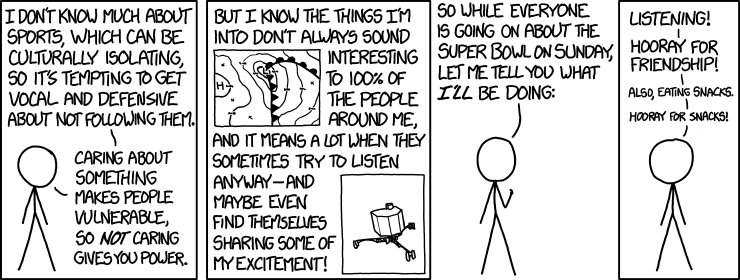
My first reaction to this was, "Yes! Exactly! This helps me reconcile my ambivalence about football with my desire to participate with friends' appreciation for it." How often I've wished to have a friend who loves cycling (or planetary science or electronic music) as much as I do -- and how wildly I've enthused when I find someone who does! This revealed a bridge.
Last week, a new friend from work invited me over to his house to watch the Superbowl. We've had a great deal of trouble coordinating our schedules to get together (for months now), so the game seemed like a perfect opportunity, lubricated by my newfound insight from Mr. Munroe. But the more I thought about it, the more I dreaded sitting and watching the game with him: it felt like I was poisoning the young relationship, as I anticipated pretending not to hate every minute of the game while trying to enjoy his company. I heard myself think it: "hate every minute of the game." Wow. I realized that I didn't really appreciate the depth of my antipathy.
So I started looking more closely to see what was bugging me. Reversing the thought experiment, I imagined myself attending a live game with this friend, in a stadium, and I could see myself actually enjoying the experience (chilly though it might be). But, as I pictured myself watching the Superbowl on the TV in the comfort of my friend's living room, I felt waves of revulsion. I realized it's not the game, not the athletes, not the gender stereotypes, none of that: it was the unrestrained, unabashed, even celebrated commercialism.
This is what I react to, that I find so deeply repellant; it feels like an utter surrender of our collective intellect to the vast and growing powers of our media. And it's not limited to the game; during the weeks and months before the Superbowl, the most powerful corporations vie for seconds-long spots in front of its audience. They wave red capes of teasers -- ads for ads -- before the eagerly anticipating throngs; commentators on the ads offer critiques on their quality, cost, and effectiveness; office, bar, even dinner-table discussions center around which ads are best and which commentators got it wrong. Entertainment corporations vie for the right to present their performers during half-time, performers whose careers are ads for themselves, and another population of commentators weighs in on the process, and more office, bar, and dinner talks are given over to media content. By the time the actual Superbowl comes around, there's as much or more anticipation of the propaganda events as the sporting outcomes. The propaganda for the propaganda for the game has become the main event, and the game has become a field on which the sport of media is played.
Watching the Superbowl, I am excruciatingly reminded of our elections: our leaders have become fodder for the entertainment machine in the same way that sports have. The metaphor of the horserace is no longer as useful for our democratic process as the pre-Superbowl ad campaign: meta-levels of ads and commentary and polls folding in on themselves to the point that the candidates for office become superfluous. To this degree, we have ceded our democracy to the media.
The fact that the navel-gazing echo-chamber of the media industry is masturbating to pictures of itself is neither my deepest concern nor particularly surprising. The most painful aspect of all this for me is the fact of our gleeful participation in it, the handing over of power in the broadest sense. I feel thrown into a scene from Brave New World, with crowds of beautiful minds swept away by tsunamis of mindless distraction, grateful for the relief from choice that the media provides, paying the fare for the ride without thought (by definition) to its cost to themselves. I half expect to see pink clouds of Soma wafting through the Superbowl stadium and falling lovingly from the television speakers. I think to myself, "I'm glad I'm not a Delta."
This, of course, is an unmitigatedly cynical thought. Like all of us in the West, I am a consumer of ads and, even if I tell myself I don't, I'm sure I surrender more of my free will to their sway than I admit. Conversely, not all who consume ads -- not all who enjoy them -- give over the entirety of their intelligence and choice to them. And our degree of choice, of free will, is, I've come to believe, much, much smaller than we generally care to consider, so avoiding its surrender is proportionately difficult. Regardless, I have decided not to resist my antipathy toward the media's coup over US-rules football; my friend and I have rescheduled to another day.
I had the thought to start (or join in on, as it's likely others have thought of it) a hashtag poking fun at the Superbowl: #nationalsportsingday. This morning's cognitive perambulations have led me to a different idea: #nationalcommercialingday. Raise awareness -- but really, not nominally; let's actively be aware here. The media are not evil, or at least they are only as evil as we empower them to be. We don't need to boycott them, but rather merely be mindful of what we consume. Let us choose what we choose because we like it, not simply because it seems to be the only choice. It's not useful for the media to go away, but it is useful for us to mind how much we let them run things. So, let's celebrate our choice on #nationalcommercialingday.
Sunday, January 25, 2015
Rings True
This piece has been a long time coming: the create date on the file folder goes back to September of 2013. That month was an especially challenging time of my life and things didn't let up for more than year after that. It's not an accident, then, that this piece is fairly tumultuous and noisy -- even painful at moments. That said, it is ultimately about the process of finding one's truth, learning to hear and listen to that voice that is most personally meaningful, which has also been a theme of my life since I started writing this.
The inspiration for the piece came from Hans Christian Andersen's story of the same name. From my first reading of it years ago, the tale captured for me that sense of seeking something hard to identify and even harder to direct oneself toward and, ultimately, grasp. Andersen of course uses strongly Christian imagery in his story; as an atheist, I have a different relationship to what he sees as a spiritual journey, but the experience he describes, however one interprets it, is one that resonates powerfully with me. I did not directly follow Andersen's allegory here, but rather took his metaphor for the call of the spirit -- The Bell -- and developed it to represent my own experiences with truth seeking.
As it evolved, the piece fell into three sections, the order of which is not meaningful beyond that I felt they worked musically. Of the three, the first section plays the most literally with the idea of seeking something. In short order, it begins to explore the ways in which we find ourselves distracted from our search by pleasant things and by goals and ambitions; as our attention is increasingly focused on these latter, it's easy to lose contact with that which initially called to us. In the second section, I feel around the idea that we sometimes rebel against relatively empty ambitions and seek reconnection with that truth through the rich and compelling beauty of religious and spiritual practices. The aid that these practices provide in locating our truth, however, can be fragile and is often and painfully derailed by the intrusive demands of day-to-day life. The third section explores the challenge of the inner path, how difficult it can be to distinguish the ring of truth from all the other voices -- thoughts and feelings, ideas and sensations -- within us. Throughout the whole piece, though, chimes the bell, even if, as time goes on, it rings more softly and less frequently.
Generically, this is a mix of musique concrete with synthetic and sampled percussion. I love ambient sound and delight in listening to the symphony of the city or the conversations of crows or the peculiar hum of my refrigerator. On the other hand, as I've discussed elsewhere, for me what distinguishes noise from music is the presence of a sense of intention, of direction. Thus, it is my intent -- and hope -- that this work comes across as more than a cacophonous collection of found sounds and actually leads the listener through a sequence of meaningful experiences. Just as it's not an accident that this is a noisy piece, it's also not an accident that it took me nearly a year and a half to complete it; along with being emotionally confronting (for me, at least), it is perhaps the most complex piece I've written. I spent a lot of time locating samples, reordering and layering them, moving them about in aural space, all with the goal of replicating in real sounds my internal sense of the task of finding my truth. In other words, working on the piece was itself an act of authenticity, of distinguishing, listening to, and following my own bell.
Technical notes: This piece was created in Apple's Logic Pro 9 and its native plug-ins; it uses sounds recorded from a Yamaha S-08 synthesizer and lots of real-world samples from Freesound.org and recorded from public broadcast resources. The voice of The Bell was created with Arturia's Moog Modular V.
Saturday, December 13, 2014
A New Beginning
I am opening a private practice! Starting in December of 2014, I will be taking new clients in Towson, MD. It will be a general practice, conducting psychotherapy with folks with a wide range of concerns, but I will also be specializing in working with artists, musicians, and creative people of all kinds. For more information on this focus, see my introductory web page. My general practice is described here and here. The link from my profile page will take you to the latest update on my professional blog.
My intention is to keep this blog as a personal creative outlet, so if you know someone who is interested in my professional work, please refer them to the above links.
My intention is to keep this blog as a personal creative outlet, so if you know someone who is interested in my professional work, please refer them to the above links.
Sunday, September 7, 2014
Too Much Death Can Make You Cranky
My apartment building has 10 units and shares one washer and one dryer.
This is usually not a problem. One recent Saturday afternoon, I started a couple batches of laundry. After I got the first one into the dryer and the second into the
washer, I then unintentionally fell asleep on the couch. When I woke up -- at least 15
minutes after the dryer stopped, I'm sure -- I went down to the laundry
room and found that someone had removed the my load from the washer, piled it
into my basket the top of the dryer, and started their own load in the washer.
That's just rude, I thought to myself. Is your life really so important that you can't wait 15 or 20 minutes to do a load of laundry on a weekend? So, after tromping upstairs to get something to put the dry laundry in, coming back down, sorting it, loading the wet laundry into the dryer, and carrying the dry load upstairs, I wrote a little Post-It note and took it back down to put on the dryer door: "DO NOT REMOVE LAUNDRY." I also set myself a timer to go off when the dryer was done (45 minutes) so I wouldn't be late. Proud of myself for being such a good boy (by not being more provocative with my note and being more mindful of the dryer cycle), I sat down to work at my computer.
Forty-three minutes later, there is a loud knock at my door; I answer and a small, older woman is standing in the hall, looking impatient. She says, "The dryer is done. I'm waiting for it."
Now, I'm just pissed off. I'm thinking, What's her problem? Still, gotta get the laundry out before it wrinkles, so, keeping my thoughts to myself, down I go; she waits upstairs, also silent, facing out the front door of the building. As I sort my stuff from the dryer, I'm grumbling to myself, thinking about how one could bring such a pestilentially rude person around to the point of view that we all have to live together here and how it's much easier for everyone if we just have a little patience, when she comes down into the laundry room and starts pulling her stuff out of the washer.
I decide to try a softer approach and ask, "What's your name?" She tells me. "I'm David. Nice to meet you," I find myself saying. "You, too," she says. "I'm tired," she continues. "I just came from the fifth funeral I've been to in two months and now I come home and have to do laundry."
Did I hear that right? "That's a lot of funerals," I say. "Yeah. First my mother, then my sister two weeks later, then my niece two weeks after that, then my nephew two weeks after that, then today..." I didn't catch the last person; I was too stunned. "I've been rearranging the furniture so much my kids are yelling at me to leave it alone." "Well, we all cope with loss in our own way," I commented. Listening to my heart break for this woman, I decided it was okay by me if she was a little impatient.
It's a basic human pitfall to assume that "bad" behavior on another's part is due to a personality flaw -- like concluding that she's "a pestilentially rude person" -- rather than considering that they may be struggling with some difficulty. It's a mistake I made that day and I'm glad for the reminder of it.
Saturday, August 23, 2014
September 1974
I watched "It Might Get Loud" tonight and was inspired by how these three excellent musicians described how they make their art and how they came to do it. In particular, Jack White's talk with his nine-year-old self and his comments about how music is often taught in public schools provoked feelings in me about my 12-year-old self taking up viola and I wondered what I would tell myself then if I had the chance.
Of course, at age 12, I had no way of understanding most of what I was going to go through during the next 10 years -- musically or otherwise -- even if I could pass the wisdom of hindsight back to that version of me. But I realized that I am still struggling with many of the same things 40 years along, so taking a moment to articulate that advice for myself seemed like a useful exercise. If I am fortunate, I will be more capable of heeding it in my middle- and old-age than I was in my adolescence.
Sixteen Things I Would Tell My 12-Year-Old Self Taking up Viola
- This instrument has a beautiful voice. Let yourself fall in love with it.
- To play certain kinds of music, you may need to follow some rules. However, there aren’t actually any rules.
- You can play anything on this instrument that your skill will allow. (Go ahead; play Led Zeppelin if you want.)
- If you don't have the skill to play what you want, let that be the reason to practice.
- Practice does not require suffering, but it does require effort. Keep at it.
- It’s okay to make practice fun. It’s also okay for it to be intense.
- Listen for what wants to be played.
- Letting yourself go may be scary, but taking risk is the only way to real satisfaction.
- Make horrible noises.
- Experiment. Dangerously.
- If you ever start to wonder why you’re doing this, stop what you’re doing and just play what feels good.
- Learn to measure others' feedback against your own sense of what works. Give yourself time for this.
- Every teacher has something to offer you. Listen especially closely to the ones that lead you to wonder.
- Be inspired.
- Put your inspiration to use.
- When in doubt, go with what feels true.
Monday, May 5, 2014
Maxed Out
Things have been changing around here quite a bit since my last post. Along with goings on in my personal and professional lives, I've taken a bit of a left turn musically. As a result of increasing frustration with the bugginess and other limitations of the Moog MMV, I looked into alternative softsynths that would give me greater power and flexibility. While I was engaged in that search, I serendipitously ran across a reference made by Laurie Spiegel to Cycling74's Max/MSP as one of the only programs that allows for real musical invention, not limiting composers to established tonalities, rhythm structures, or even synthesis models. Looking into it, I was at first intimidated by the learning curve (and second by the cost), but after playing around with it* during the 30 day free trial, I decided to take the leap.
I've been pleased with the results so far. The learning curve is steep, but the program rewards jumping in and thrashing about. Forum discussions are likely to contain basic questions answered by experienced programmers and there are some very excellent tutorials on YouTube and elsewhere for folks like me who learn best by observing.
I have made exactly zero music with it so far. Part of this is that I have yet to figure out how to implement an idea I have that is especially well suited to Max; another part is that that project has fallen by the wayside as I have become entranced by another, more construction-oriented, project: the additive synth. Max's potential for additive synthesis is one of the big reasons why I decided to go with it: the size and complexity of what one can build is limited only by the processing power of one's computer. Plus, technically, additive synthesis is relatively simple, so it seemed like a good first project. Below is a screenshot of the latest iteration (#8).

This version is based on adding sines in the overtone series. The instrument allows full control over amplitude and phase of each overtone, along with exponential stretching the overtone series (partials are raised to an exponent ranging from 1 to 1.125) allowing the 8th partial to be stretched relative to the fundamental more than an octave. The fundamental follows a MIDI tempered scale. What I am enjoying about this project is the appreciation it is giving me of Fourier analysis: how different aspects of how a sound is constructed change its timbre. Although this has so far been primarily a learning project, I am now at the point where I can begin to make a more practical instrument out of it.
So what this means for my compositional productivity is that I'm probably not going to be producing much in the near future. However, as I gain skill with this new program, I expect it will be easier (and faster) to make music with it, so in the long run, I expect it to facilitate my output. In the medium-term, I have this idea and my work on the additive synth has helped me understand better how to implement it, so maybe soon.
In the meantime, please lend your attention to some very interesting work by a musician I ran across last fall. All of his other work (that I've heard, anyway) is much closer to straight-ahead jazz, rock, even a little punkish, but this album is mostly about timbre -- and you know I'm all about that.

*PS: For those who might be interested, there is an open source program that does essentially the same thing as Max: it's called Pure Data. I spent a fair amount of time considering it Pd, too, since, being open source, it's free. I went with Max because it has better support for non-programmers like me, but for those who are unintimidated by geekspeak and open source forums, Pd is a great program.
I've been pleased with the results so far. The learning curve is steep, but the program rewards jumping in and thrashing about. Forum discussions are likely to contain basic questions answered by experienced programmers and there are some very excellent tutorials on YouTube and elsewhere for folks like me who learn best by observing.
I have made exactly zero music with it so far. Part of this is that I have yet to figure out how to implement an idea I have that is especially well suited to Max; another part is that that project has fallen by the wayside as I have become entranced by another, more construction-oriented, project: the additive synth. Max's potential for additive synthesis is one of the big reasons why I decided to go with it: the size and complexity of what one can build is limited only by the processing power of one's computer. Plus, technically, additive synthesis is relatively simple, so it seemed like a good first project. Below is a screenshot of the latest iteration (#8).
This version is based on adding sines in the overtone series. The instrument allows full control over amplitude and phase of each overtone, along with exponential stretching the overtone series (partials are raised to an exponent ranging from 1 to 1.125) allowing the 8th partial to be stretched relative to the fundamental more than an octave. The fundamental follows a MIDI tempered scale. What I am enjoying about this project is the appreciation it is giving me of Fourier analysis: how different aspects of how a sound is constructed change its timbre. Although this has so far been primarily a learning project, I am now at the point where I can begin to make a more practical instrument out of it.
So what this means for my compositional productivity is that I'm probably not going to be producing much in the near future. However, as I gain skill with this new program, I expect it will be easier (and faster) to make music with it, so in the long run, I expect it to facilitate my output. In the medium-term, I have this idea and my work on the additive synth has helped me understand better how to implement it, so maybe soon.
In the meantime, please lend your attention to some very interesting work by a musician I ran across last fall. All of his other work (that I've heard, anyway) is much closer to straight-ahead jazz, rock, even a little punkish, but this album is mostly about timbre -- and you know I'm all about that.
*PS: For those who might be interested, there is an open source program that does essentially the same thing as Max: it's called Pure Data. I spent a fair amount of time considering it Pd, too, since, being open source, it's free. I went with Max because it has better support for non-programmers like me, but for those who are unintimidated by geekspeak and open source forums, Pd is a great program.
Subscribe to:
Posts (Atom)