“Here,” said Mark, my high school best friend. He had handed me a chisel that looked ancient except for a brand new wooden handle that was surprisingly heavy and smooth in my hand. “What is it?” I asked. “Bodark. My dad made it.” Mark's dad, Joe, collected and restored old woodworking hand tools; the wood he had selected for the chisel's handle was new to me, a tree I later learned is native to New Mexico, where Mark and I were growing up, also called Bois d'arc and Osage Orange. It felt incredibly dense and hard, like you could drive nails with it, and it had a beautiful, rich, red-brown grain that shimmered softly under the linseed oil finish. “Bodark, huh? Never heard of it.” “Yeah, Dad has some growing out on the North 40 and he likes to use it for tools 'cause it's so tough.” That memory is more than three decades old, but I can still feel the heft of the handle in my hand. I remember, too, our subsequent conversation about how difficult bodark is to work and that Joe constantly had to resharpen his blades when doing so.
Joe is a remarkable man. He is not obviously so: in appearance he has perhaps a bit more nose and less chin than might otherwise become him and a slight stoop that could come simply from being tall or may be the result of having taken a German sniper's bullet in the neck in World War II. Neither is he overtly muscular, but he has always had an air of surety, as one who harbors great strength and great love. As a boy in the throes of puberty, I found him intimidating, despite his friendliness. Whenever I see him, he often betrays a conspiratorial twinkle in his eye, like he knows something I don't, which over the course of the decades of my friendship with Mark, I have frequently found to be the case. By vocation, Joe taught high school industrial arts, wood working and drafting in one of the toughest schools in the city and, as I recall, well respected by his students and peers. By avocation, he is or has been a collector, a woodcarver, a carpenter, a proprietor, a dog breeder, a vintner, a marksman, and -- how to say it? -- the maker of the best tamales I have ever tasted.
Since Mark and I were young, I had coveted Joe's tamale recipe. Unlike Mark, I was not native to New Mexico, but I fell in love with its cuisine soon after transplanting there at age 12. The tamales at Mark's house were amazing, with smooth masa that was tender and not too thick and a filling that was just hot enough with ripe, red New Mexican chili peppers to demand your attention, but not so hot as to overpower their rich flavor. And there was something else, too, a mouthfeel, a creaminess, a rich depth to the filling that I could not place; Joe said that was from his secret ingredient. For years, I begged Mark to tell me what it was, but he didn't know either and Joe wasn't telling. Once, when we were teens, Mark asked Joe to teach him how to make the tamales and Joe said, okay, just get up early next time he made them and he'd show him everything. On tamale-making day, Mark got up at 5:00 a.m. and went into the kitchen, only to discover Joe had already finished the filling. “You got to get up early to make good tamales,” Joe said. Eventually, when Mark and I were well into our thirties, Joe gave his secret to Mark, which he then shared with me; I won't betray it here, but suffice it to say that it both shocked me and made perfect sense given the history of this peasant food. To this day, I have never found an equal to Joe's tamales.
It seems that whatever Joe sets his mind and hands to he does exceptionally well. His homemade wine is the only such wine that I have ever tasted that was worth drinking, and, more than that, very tasty. He doesn't limit himself to brewing wine from grapes, either: one year when Mark and I were in our early twenties, his family's apricot tree, a towering green orb of Bunyanic proportions, provided such a banner harvest that they couldn't eat, give away, can, or dry the fruit fast enough. So, Joe pitted the overripe orange lumps, tossed them into a barrel, and let them sit until they “got real good.” The following spring, Mark brought a precious bottle of this experiment's results over to my apartment to share. Like most wines based on sweet fruit, it was strong, but it drank with the mellow smoothness of its ripe parentage. That's Joe: subtlety in strength.
Scattered about Joe's home are various pieces of handcarved furniture, Joe's handiwork. I recall most clearly the beds: head- and footboards with radially symmetrical petal designs in a bas relief and square posts with finials. The wood is dark and solid; the beds feel as firmly planted as if the mattresses were on the floor. Apparently Joe began carving at a young age; I believe he carved the master bed as a wedding gift. And, along with his love of carving has come a passion for hand tools, of which he has literally hundreds. Mark showed me his workshop once: walls almost entirely covered with hand chisels, lathe chisels, handsaws, planes and other tools of all types and sizes, none new and all carefully cleaned, restored, and brightly sharp.
Not long after he retired from teaching, Joe was diagnosed with prostate cancer. “Doctors give him a year or two,” was Mark's news. Joe proceeded to take up a fight with his township over some land he owned and hired out to be farmed – a few acres that the family ironically calls “the North 40” – but that the town wanted to develop. After winning that battle, which took a couple of years, he tore up a knee while chopping down a bodark tree, so he got a knee replacement. He spent the next several years maintaining and upgrading properties he has scattered about the state and yard-saling every Saturday with Mark – he loves a good deal and has a sharp eye for good quality hand tools that just need a bit of dressing up.
It's now been twenty years since the doctors gave him his terminal sentence and, like the bodark he works with, his toughness has surprised pretty much everyone but those who know him well. Recently, though, his health has been dealt a series of heavy blows and it's beginning to look like his time here is winding down. Of course, Joe has exceeded people's expectations so many times, I feel like nothing is sure, but even bodark breaks down eventually, I guess. In any case, for me, Joe has always been a model for how to live your life, for what it means to be a man. He exemplifies listening to your heart and acting on your truth, loving life and those with whom you choose to share it to the best of your ability, and doing so unpretentiously. I suspect Joe would take issue with at least some of my characterizations of him and it's certainly possible, even likely, that they come in part from the awe with which a younger generation may view its elders, but regardless of whether he would accept my description of him as accurate, this is who he has been for me and represents the gifts he has given to me. I am grateful, and hopefully a better man, for knowing him. I think of him whenever I see a bodark tree.
Saturday, August 27, 2011
Sunday, July 10, 2011
OMGary
I've been reading a lot of webcomix of late and, in a particular series recently, a main character was wearing a t-shirt that said, "Gary F[deleted]ing Numan." Being of a certain age (about 20 years older than the characters in the strip), my recollection of Gary Numan harkens back to the early '80s and MTV's infancy. My brother and I would sit for hours bemoaning the young network's poor musical fare (which was nonetheless clearly not bad enough for us to do something else with our time). We agreed, however, that Gary Numan's "Cars," the only work of his that they ever played, was pretty good. (And, honestly, despite my classically-trained snobbishness and stunning inability at the time to appreciate much of the subtleties of better pop music, I really liked the song and didn't mind much when it sunk its massive hooks into my brain for days.)
Fast forward 30 years and I see the t-shirt in the comic and I think, "Why would a character who is a professed indy connoisseur wear a shirt emblazoned with the name of a one-hit-wonder from 1979?" Thanks to the magic of the Internet, I quickly discovered that Mr. Numan was far from an OHW in the UK and, in fact, was a powerful influence on a range of musicians who are better-known in the USA than he is. (I am in the happy process of delving into his oeuvre now.) Regardless of that, however, I was also pleased to find available on YouTube the very MTV video remembered from my youth and, upon viewing it, instantly had my brain once again skewered the deep hooks of "Cars." It didn't take long for me to think "Hey, this would be fun to cover." And so I did.
When I hear an artist do a cover, I am most interested in what that artist brings to it. What of her/his/their own voice is there? How does the piece gain from its translation through the new performer? Thus, in taking this on, I had to ask myself the same thing: what could I bring to the piece that might be a worthwhile offering? I have done my best to listen to what the song inspires in me and to infuse that into this arrangement. The process has been, as have all of these recent projects, an education, not only from a technical standpoint, but in terms of learning (and relearning) my own artistic process. I'm pretty pleased with how it came out and I hope you enjoy it as much as I enjoyed putting it together.
Some quick technical notes: Every sound in this performance, except for some of the drum samples, is entirely synthetic. This includes the voice, which was generated using the text-to-speech function native to Mac OSX. My original idea was to auto-tune the voice to the melody, but this proved to be beyond my current technical know-how (and possibly my software) and I liked the way it turned out anyway.
Reorg
I have been unhappy with the quality of the audio in the video conversion required to post to this blog, so I decided to begin using YouTube as a host site for them and embed links from here. This has, in fact, resulted in much better audio for my recordings, so I have re-uploaded all the previous pieces and repost them here so that listeners may have the opportunity to listen to the clearer production.
Thanks for listening and, as always, please post comments here on the blog.
Thanks for listening and, as always, please post comments here on the blog.
Sunday, June 19, 2011
Acoustic Debris #1
As W. A. Mathieu so eloquently put it, we live at the bottom of an ocean of sound and the ambient acoustic world through which we drift and swim is a rich part of my waking life. I love found-sound work, from the industrial spookiness of David Lynch to the enlightened simplicity of John Cage. Since I got my DAW, I have fantasized about different found-sound work I might do, but believed I was limited by the fact that, at this stage, I have no decent quality recording equipment and no budget to purchase good quality samples.
Once again, the Internet comes to the rescue: while trying to find some choir samples that I could use as a base for a good synth-choir voice, I discovered a remarkable open-copyright repository of sound samples called The Freesound Project. They cover pretty much any sound type one might imagine, from bird and insect calls to industrial noise to biophysical sounds to, happily, choir. Once I began perusing the archive, I was quickly sucked into their universe of noise and found myself downloading samples with the thought to play around with building a found-sound work. The below piece is the result; all of the sounds come from The Freesound Project.
Not having done anything like this before, this is, naturally, as much a study as a work of expression. Some sounds seemed to want to go together and, when played concurrently, created new sounds, evoking new thoughts and images; some are related and some are very much unrelated. It's exciting to be able to combine sounds that could not exist simultaneously in the real world and yet nonetheless feel acoustically meaningful when combined. Sequence was interesting, too, as I discovered what sounds seemed to make sense to follow others, sometimes inexplicably.
There is no story here, despite the concreteness of the samples. I tried to build something of an emotional arc, following a sense of tension, but this is at bottom nothing more than a mental wandering, or even skipping about, in soundspace.
Saturday, May 28, 2011
Koyaanisqatsi
It would be an understatement to say that I'm not a huge fan of Philip Glass. That said, there are a handful of his pieces that I like and Koyaanisqatsi, its initial theme and the work as a whole, I actually think is brilliant, even though much of its effectiveness must be credited to his visionary collaborator, Godfrey Reggio. The job of a film soundtrack, normally, is to guide the viewer as unobtrusively as possible in how to feel about the images being presented; in the case of Koyaanisqatsi, the soundtrack carries the additional burden of serving as dialog (or monologue, in this case) and so remains very much in the foreground. As a consequence, it is intended to be heard overtly and, therefore, can theoretically stand on its own. Although, like any soundtrack, I cannot hear the music without seeing in my mind's eye the images it was written to accompany, I think in this work, Glass transcended himself and created a work that is both surprisingly varied and yet emotionally relentless, giving Reggio the hammer he desired to drive home the film's message. In the opening theme, Glass provides a musical foreshadowing of both the grace and the violence that he and Reggio have in store for the audience. Because of that, and for other reasons, this brief, transparent work remains one of my favorites from the film.
I started this project as a quick bit of playtime before starting on my next, more challenging piece and I had an idea that I'd like to do a spoof of Glass's works; given how homogenous most of it is, a sequencer like Tracktion makes this pitifully easy. However, as I began to work on it, a) I realized that a really good spoof would just end up sounding like another Glass piece and, really, why does the world need another piece that sounds like what we've already got too much of, and b) I recalled that there were a couple pieces of Glass' I actually liked. As a result, I remembered Koyaanisqatsi and looked it up on YouTube, where I discovered that the entire film is actually available (although it is in relatively low resolution and, since the images are the heart of the film, if you want to see it, do so on DVD or Blu-Ray). After listening to the opening theme, I heard again how elegant and transparent it was and thought, "I bet, just for fun, I could transcribe that in about five minutes." And, indeed, it was even simpler than I had remembered, with just four voices alternating and building on each other.
As with most of Glass' music, this should be listened to at high volume.
A Glass devotee will notice that, in this arrangement, I doubled three voices and added two cycles (eight measures). As the preface to the film, it appropriately does not build to where it might; however, as a standalone piece, I felt that it wanted to and could be indulged a little. With the above additions, it rises to the cacophony that it seems to reach for when it is pruned in its role as an entree to the film, which is something I love about the piece: that, by merely stacking a few well-defined linear motifs, Glass carries us from foreboding to damnation in just a few bars, finally leaving us hanging, drifting alone in empty space, wondering how long eternity will be.
Sunday, May 8, 2011
Debussy: Reverie
Well, I've been working on this (and kvetching about not having finished it) for so long, that this may be a bit anti-climactic, but, at last, it's done -- or done enough, anyway. This is the piece I've been working on since February that the completion of which has been variously interrupted by school demands, computer issues large and small, and operator problems. It feels like a long time coming and a commensurate relief to post it. Strictly speaking, it's unfinished; there are some mixing issues that I could fix and I still feel a little lost as regards how to best to implement dynamic expression, but, between the facts that this is my first big project and that I am really ready to move on to something new, I decided it was time to call it done. All that said, I'm actually pretty happy with it overall.
It's no accident that I chose this piece for my first big synthesizer arrangement. When I was in my teens, my father brought home a copy of Isao Tomita's Snowflakes are Dancing, and in it Tomita did an arrangement of Reverie. Up to that point, the only real synthetic music I had heard was Wendy (then Walter) Carlos' Switched on Bach and The Well-Tempered Synthesizer, which we used to listen to all the time. Tomita's virtuosity on the keyboard and timbral imagination was so radically different from what Carlos had done, at first it seemed to go too far, but the more I listened to it, the more I heard his genius. Although I don't intend to emulate him, I do aspire to Tomita's level of imagination; I still hear new things in his work every time I listen to it.
My arrangement here is not intended as a "remake" of Tomita's performance (that would be almost as silly as remaking King Kong). Instead, as Reverie is simply a piece I have loved for many years and, despite its relative simplicity, I hear many voices woven into it, so it seemed like a good place to start learning the basics of synthetic music production. Only one of the voices in this arrangement is original; several are mods of stock voices, and one or two are unaltered stock. I ran across the two voices at the beginning of the piece quite by accident, but they set the tone for the rest of the work.
I hope you enjoy this as much as I have enjoyed making it.
Friday, April 22, 2011
Crystalized Intelligence
Unsurprisingly, the need to catch up on my schoolwork following the terminal diagnosis of my long-suffering Toshiba Portege has left me with little fun time. Additional cycles have been commandeered by the learning curve inherent in two new OSs (Mac OSX and iOS). Of course, they are living up to their reputation for being intuitive, but I suspect they would be intuitiver if it were not for all the years I spent forcing my intuition into the mold that Microsoft engineers insisted it should fit. Nonetheless, there have been a few moments here and there during which I have been able to futz around with my current project.
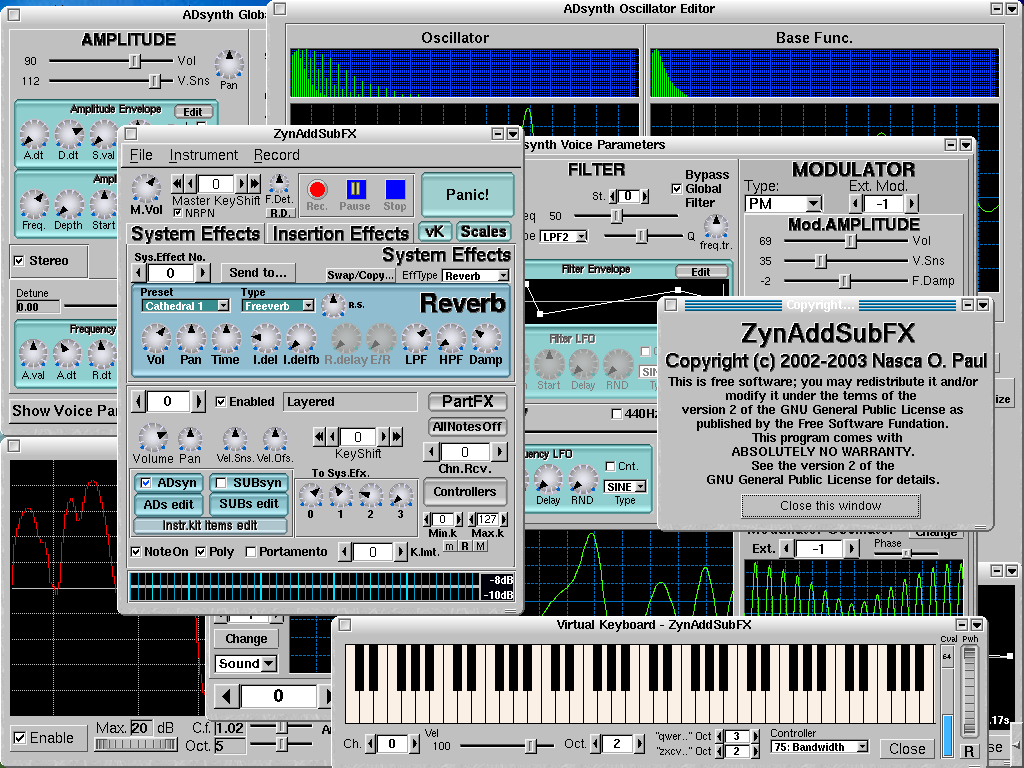
As I mentioned in my last post, one of the first things I needed to do following the port to Mac was to come up with an alternative to ZynAddSubFX, an extraordinary VST plugin that I was using for several key voices. With some searching, I was able to find another free softsynth compatible with my DAW that, although it is qualitatively a different beast from ZynAddSubFX, it was nonetheless designed to be a fairly sophisticated sound generator: it's called Crystal. The good news is that it is capable of some pretty impressive noises and there is an iOS version too, so I can take it with me and play with it away from my desktop. Unfortunately, however, all of the presets, while being very creative and interesting, are out of character for what I've been working on. Further, its interface is not exactly intuitive (not that ZynAddSubFX is), so it's taken some time for me to get a sense of which end to blow in.
Despite my student status, I am of an age at which learning curves present steeper slopes than they once did and between OSX, iOS, and Crystal (not to mention iWorks and a handful of other partially and completely new friends), I feel like I've done more than my share of climbing of late. That said, I have had a few minutes here and there to mess around with the project and I feel like I'm pretty close to where I left off when the Toshiba started showing signs of byting the dust. The semester will be over in a week or so (whether I'm ready for it to end or not) so I hope to have some real playtime in early- to mid-May and to get this long overdue project polished and posted.
As I mentioned in my last post, one of the first things I needed to do following the port to Mac was to come up with an alternative to ZynAddSubFX, an extraordinary VST plugin that I was using for several key voices. With some searching, I was able to find another free softsynth compatible with my DAW that, although it is qualitatively a different beast from ZynAddSubFX, it was nonetheless designed to be a fairly sophisticated sound generator: it's called Crystal. The good news is that it is capable of some pretty impressive noises and there is an iOS version too, so I can take it with me and play with it away from my desktop. Unfortunately, however, all of the presets, while being very creative and interesting, are out of character for what I've been working on. Further, its interface is not exactly intuitive (not that ZynAddSubFX is), so it's taken some time for me to get a sense of which end to blow in.
Despite my student status, I am of an age at which learning curves present steeper slopes than they once did and between OSX, iOS, and Crystal (not to mention iWorks and a handful of other partially and completely new friends), I feel like I've done more than my share of climbing of late. That said, I have had a few minutes here and there to mess around with the project and I feel like I'm pretty close to where I left off when the Toshiba started showing signs of byting the dust. The semester will be over in a week or so (whether I'm ready for it to end or not) so I hope to have some real playtime in early- to mid-May and to get this long overdue project polished and posted.
Subscribe to:
Posts (Atom)