As W. A. Mathieu so eloquently put it, we live at the bottom of an ocean of sound and the ambient acoustic world through which we drift and swim is a rich part of my waking life. I love found-sound work, from the industrial spookiness of David Lynch to the enlightened simplicity of John Cage. Since I got my DAW, I have fantasized about different found-sound work I might do, but believed I was limited by the fact that, at this stage, I have no decent quality recording equipment and no budget to purchase good quality samples.
Once again, the Internet comes to the rescue: while trying to find some choir samples that I could use as a base for a good synth-choir voice, I discovered a remarkable open-copyright repository of sound samples called The Freesound Project. They cover pretty much any sound type one might imagine, from bird and insect calls to industrial noise to biophysical sounds to, happily, choir. Once I began perusing the archive, I was quickly sucked into their universe of noise and found myself downloading samples with the thought to play around with building a found-sound work. The below piece is the result; all of the sounds come from The Freesound Project.
Not having done anything like this before, this is, naturally, as much a study as a work of expression. Some sounds seemed to want to go together and, when played concurrently, created new sounds, evoking new thoughts and images; some are related and some are very much unrelated. It's exciting to be able to combine sounds that could not exist simultaneously in the real world and yet nonetheless feel acoustically meaningful when combined. Sequence was interesting, too, as I discovered what sounds seemed to make sense to follow others, sometimes inexplicably.
There is no story here, despite the concreteness of the samples. I tried to build something of an emotional arc, following a sense of tension, but this is at bottom nothing more than a mental wandering, or even skipping about, in soundspace.
Sunday, June 19, 2011
Saturday, May 28, 2011
Koyaanisqatsi
It would be an understatement to say that I'm not a huge fan of Philip Glass. That said, there are a handful of his pieces that I like and Koyaanisqatsi, its initial theme and the work as a whole, I actually think is brilliant, even though much of its effectiveness must be credited to his visionary collaborator, Godfrey Reggio. The job of a film soundtrack, normally, is to guide the viewer as unobtrusively as possible in how to feel about the images being presented; in the case of Koyaanisqatsi, the soundtrack carries the additional burden of serving as dialog (or monologue, in this case) and so remains very much in the foreground. As a consequence, it is intended to be heard overtly and, therefore, can theoretically stand on its own. Although, like any soundtrack, I cannot hear the music without seeing in my mind's eye the images it was written to accompany, I think in this work, Glass transcended himself and created a work that is both surprisingly varied and yet emotionally relentless, giving Reggio the hammer he desired to drive home the film's message. In the opening theme, Glass provides a musical foreshadowing of both the grace and the violence that he and Reggio have in store for the audience. Because of that, and for other reasons, this brief, transparent work remains one of my favorites from the film.
I started this project as a quick bit of playtime before starting on my next, more challenging piece and I had an idea that I'd like to do a spoof of Glass's works; given how homogenous most of it is, a sequencer like Tracktion makes this pitifully easy. However, as I began to work on it, a) I realized that a really good spoof would just end up sounding like another Glass piece and, really, why does the world need another piece that sounds like what we've already got too much of, and b) I recalled that there were a couple pieces of Glass' I actually liked. As a result, I remembered Koyaanisqatsi and looked it up on YouTube, where I discovered that the entire film is actually available (although it is in relatively low resolution and, since the images are the heart of the film, if you want to see it, do so on DVD or Blu-Ray). After listening to the opening theme, I heard again how elegant and transparent it was and thought, "I bet, just for fun, I could transcribe that in about five minutes." And, indeed, it was even simpler than I had remembered, with just four voices alternating and building on each other.
As with most of Glass' music, this should be listened to at high volume.
I started this project as a quick bit of playtime before starting on my next, more challenging piece and I had an idea that I'd like to do a spoof of Glass's works; given how homogenous most of it is, a sequencer like Tracktion makes this pitifully easy. However, as I began to work on it, a) I realized that a really good spoof would just end up sounding like another Glass piece and, really, why does the world need another piece that sounds like what we've already got too much of, and b) I recalled that there were a couple pieces of Glass' I actually liked. As a result, I remembered Koyaanisqatsi and looked it up on YouTube, where I discovered that the entire film is actually available (although it is in relatively low resolution and, since the images are the heart of the film, if you want to see it, do so on DVD or Blu-Ray). After listening to the opening theme, I heard again how elegant and transparent it was and thought, "I bet, just for fun, I could transcribe that in about five minutes." And, indeed, it was even simpler than I had remembered, with just four voices alternating and building on each other.
As with most of Glass' music, this should be listened to at high volume.
A Glass devotee will notice that, in this arrangement, I doubled three voices and added two cycles (eight measures). As the preface to the film, it appropriately does not build to where it might; however, as a standalone piece, I felt that it wanted to and could be indulged a little. With the above additions, it rises to the cacophony that it seems to reach for when it is pruned in its role as an entree to the film, which is something I love about the piece: that, by merely stacking a few well-defined linear motifs, Glass carries us from foreboding to damnation in just a few bars, finally leaving us hanging, drifting alone in empty space, wondering how long eternity will be.
Sunday, May 8, 2011
Debussy: Reverie
Well, I've been working on this (and kvetching about not having finished it) for so long, that this may be a bit anti-climactic, but, at last, it's done -- or done enough, anyway. This is the piece I've been working on since February that the completion of which has been variously interrupted by school demands, computer issues large and small, and operator problems. It feels like a long time coming and a commensurate relief to post it. Strictly speaking, it's unfinished; there are some mixing issues that I could fix and I still feel a little lost as regards how to best to implement dynamic expression, but, between the facts that this is my first big project and that I am really ready to move on to something new, I decided it was time to call it done. All that said, I'm actually pretty happy with it overall.
It's no accident that I chose this piece for my first big synthesizer arrangement. When I was in my teens, my father brought home a copy of Isao Tomita's Snowflakes are Dancing, and in it Tomita did an arrangement of Reverie. Up to that point, the only real synthetic music I had heard was Wendy (then Walter) Carlos' Switched on Bach and The Well-Tempered Synthesizer, which we used to listen to all the time. Tomita's virtuosity on the keyboard and timbral imagination was so radically different from what Carlos had done, at first it seemed to go too far, but the more I listened to it, the more I heard his genius. Although I don't intend to emulate him, I do aspire to Tomita's level of imagination; I still hear new things in his work every time I listen to it.
My arrangement here is not intended as a "remake" of Tomita's performance (that would be almost as silly as remaking King Kong). Instead, as Reverie is simply a piece I have loved for many years and, despite its relative simplicity, I hear many voices woven into it, so it seemed like a good place to start learning the basics of synthetic music production. Only one of the voices in this arrangement is original; several are mods of stock voices, and one or two are unaltered stock. I ran across the two voices at the beginning of the piece quite by accident, but they set the tone for the rest of the work.
I hope you enjoy this as much as I have enjoyed making it.
It's no accident that I chose this piece for my first big synthesizer arrangement. When I was in my teens, my father brought home a copy of Isao Tomita's Snowflakes are Dancing, and in it Tomita did an arrangement of Reverie. Up to that point, the only real synthetic music I had heard was Wendy (then Walter) Carlos' Switched on Bach and The Well-Tempered Synthesizer, which we used to listen to all the time. Tomita's virtuosity on the keyboard and timbral imagination was so radically different from what Carlos had done, at first it seemed to go too far, but the more I listened to it, the more I heard his genius. Although I don't intend to emulate him, I do aspire to Tomita's level of imagination; I still hear new things in his work every time I listen to it.
My arrangement here is not intended as a "remake" of Tomita's performance (that would be almost as silly as remaking King Kong). Instead, as Reverie is simply a piece I have loved for many years and, despite its relative simplicity, I hear many voices woven into it, so it seemed like a good place to start learning the basics of synthetic music production. Only one of the voices in this arrangement is original; several are mods of stock voices, and one or two are unaltered stock. I ran across the two voices at the beginning of the piece quite by accident, but they set the tone for the rest of the work.
I hope you enjoy this as much as I have enjoyed making it.
Friday, April 22, 2011
Crystalized Intelligence
Unsurprisingly, the need to catch up on my schoolwork following the terminal diagnosis of my long-suffering Toshiba Portege has left me with little fun time. Additional cycles have been commandeered by the learning curve inherent in two new OSs (Mac OSX and iOS). Of course, they are living up to their reputation for being intuitive, but I suspect they would be intuitiver if it were not for all the years I spent forcing my intuition into the mold that Microsoft engineers insisted it should fit. Nonetheless, there have been a few moments here and there during which I have been able to futz around with my current project.
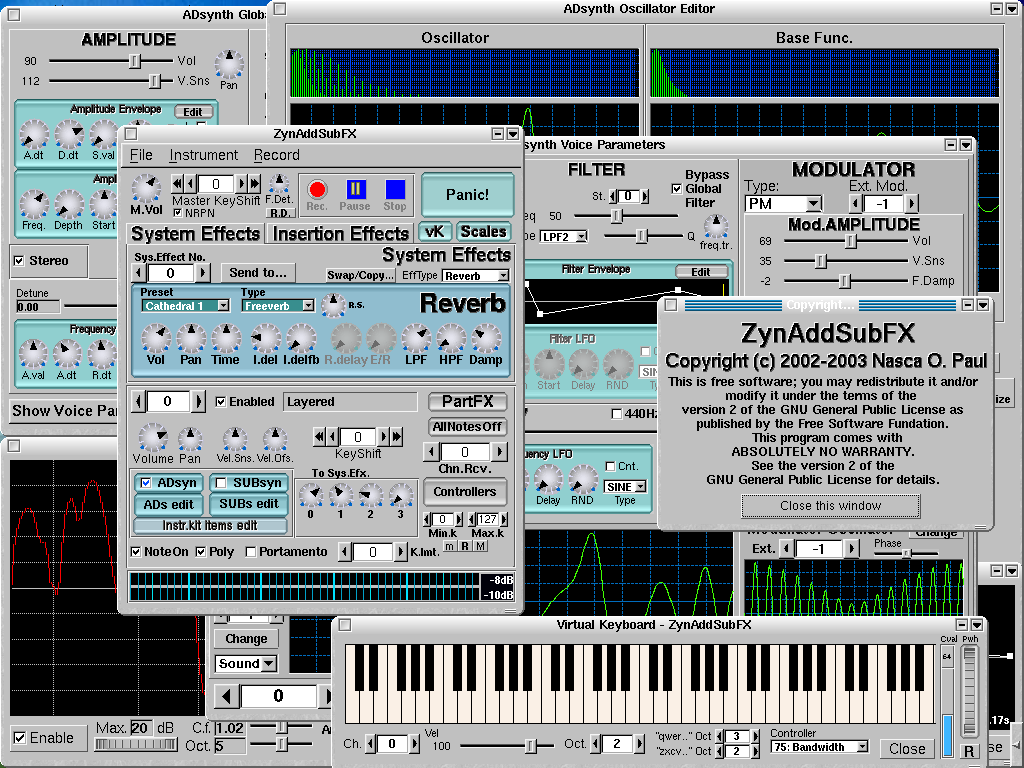
As I mentioned in my last post, one of the first things I needed to do following the port to Mac was to come up with an alternative to ZynAddSubFX, an extraordinary VST plugin that I was using for several key voices. With some searching, I was able to find another free softsynth compatible with my DAW that, although it is qualitatively a different beast from ZynAddSubFX, it was nonetheless designed to be a fairly sophisticated sound generator: it's called Crystal. The good news is that it is capable of some pretty impressive noises and there is an iOS version too, so I can take it with me and play with it away from my desktop. Unfortunately, however, all of the presets, while being very creative and interesting, are out of character for what I've been working on. Further, its interface is not exactly intuitive (not that ZynAddSubFX is), so it's taken some time for me to get a sense of which end to blow in.
Despite my student status, I am of an age at which learning curves present steeper slopes than they once did and between OSX, iOS, and Crystal (not to mention iWorks and a handful of other partially and completely new friends), I feel like I've done more than my share of climbing of late. That said, I have had a few minutes here and there to mess around with the project and I feel like I'm pretty close to where I left off when the Toshiba started showing signs of byting the dust. The semester will be over in a week or so (whether I'm ready for it to end or not) so I hope to have some real playtime in early- to mid-May and to get this long overdue project polished and posted.
As I mentioned in my last post, one of the first things I needed to do following the port to Mac was to come up with an alternative to ZynAddSubFX, an extraordinary VST plugin that I was using for several key voices. With some searching, I was able to find another free softsynth compatible with my DAW that, although it is qualitatively a different beast from ZynAddSubFX, it was nonetheless designed to be a fairly sophisticated sound generator: it's called Crystal. The good news is that it is capable of some pretty impressive noises and there is an iOS version too, so I can take it with me and play with it away from my desktop. Unfortunately, however, all of the presets, while being very creative and interesting, are out of character for what I've been working on. Further, its interface is not exactly intuitive (not that ZynAddSubFX is), so it's taken some time for me to get a sense of which end to blow in.
Despite my student status, I am of an age at which learning curves present steeper slopes than they once did and between OSX, iOS, and Crystal (not to mention iWorks and a handful of other partially and completely new friends), I feel like I've done more than my share of climbing of late. That said, I have had a few minutes here and there to mess around with the project and I feel like I'm pretty close to where I left off when the Toshiba started showing signs of byting the dust. The semester will be over in a week or so (whether I'm ready for it to end or not) so I hope to have some real playtime in early- to mid-May and to get this long overdue project polished and posted.
Saturday, April 2, 2011
...and there was much rejoicing
After a long, impatient week, the new iMac arrived this morning. I promised myself that I would get everything else set up on it before seeing how my DAW would run, but by 8pm I still had not finished installing and setting up everything I needed for an actual productive life (for example, EndNote and Quicken are still in the queue). I felt my eyes crossing at all the details yet to be handled and concluded I needed to do something nice for myself, so I decided to give the DAW a whirl.
Contrary to my earlier fears, I had run across some discussions online that indicated that Tracktion 3 should run fine on multi-core Intel processors, CPUs that were not what it was originally built for. So I began to entertain some hope -- even some excitement -- that I might not lose all the work I'd put into this new endeavor that was enabled specifically by the ridiculously marked-down copies of Tracktion 3 made available following its discontinuance. Replacing it with something equivalent would run several hundred dollars.
The good news is that -- after some initial crashes and accompanying panic -- an updated version of Tracktion seems to be stable on the Mac quad-core: yay! The bad news is that one of my principal softsynth plug-ins, ZynAddSubFX, is currently only available for Windows and Linux (boo!). There apparently was a MacOS port some years ago, but the link is dead (apparently long since). As a consequence, I will need to rebuild in a new softsynth the voices now missing from my arrangements, something I am as yet unskilled in. But, it will be a good learning experience!
Of course, after a week without a computer, I am terribly behind in my academic work: dissertation (of course), class paper (last one ever!), a couple of presentations (not the least of which is for my daughter's school), and a menagerie of minutia. So, my seemingly Sisyphean music project is going to roll further back down the hill, but at least it looks like it won't disappear.
Contrary to my earlier fears, I had run across some discussions online that indicated that Tracktion 3 should run fine on multi-core Intel processors, CPUs that were not what it was originally built for. So I began to entertain some hope -- even some excitement -- that I might not lose all the work I'd put into this new endeavor that was enabled specifically by the ridiculously marked-down copies of Tracktion 3 made available following its discontinuance. Replacing it with something equivalent would run several hundred dollars.
The good news is that -- after some initial crashes and accompanying panic -- an updated version of Tracktion seems to be stable on the Mac quad-core: yay! The bad news is that one of my principal softsynth plug-ins, ZynAddSubFX, is currently only available for Windows and Linux (boo!). There apparently was a MacOS port some years ago, but the link is dead (apparently long since). As a consequence, I will need to rebuild in a new softsynth the voices now missing from my arrangements, something I am as yet unskilled in. But, it will be a good learning experience!
Of course, after a week without a computer, I am terribly behind in my academic work: dissertation (of course), class paper (last one ever!), a couple of presentations (not the least of which is for my daughter's school), and a menagerie of minutia. So, my seemingly Sisyphean music project is going to roll further back down the hill, but at least it looks like it won't disappear.
Monday, March 28, 2011
Decomputerized
One problem with computer music is that it requires a computer. Actually, this isn't an inherent problem, unless there is a problem inherent in the computer on which the music is supposed to be being made. In my case, such a problem has developed: my computer is terminally ill. Being one who believes in allowing the dying to pass honorably, I am taking steps to relieve my old colleague of its duties before senility sets in by ordering a replacement. However, there has been a sea change in computing technology in the time since we began working together nearly five years ago and the new young hot-shot on its way has a multi-core architecture. Although the software with which I have been working is designed to be cross-platform (my old computer is a PC and the new one will be a Mac), it was written during the now seemingly distant single-core era and rumor has it that it does not get on well with the dual- and quad-core designs of today's machines. Thus, it is up in the air whether or not my late-blooming but still fledgling passion for music synthesis -- and the reason for this blog -- will be curtailed before it even gets a fair start.
This blog is turning into more of an "Excuse of the Week" than the homage to ADSR that I had hoped. Still, to succeed, one must first fail many times. Onward, into a brave new iWorld!
This blog is turning into more of an "Excuse of the Week" than the homage to ADSR that I had hoped. Still, to succeed, one must first fail many times. Onward, into a brave new iWorld!
Sunday, March 20, 2011
Lost in Thought (-ish)
According to the Merriam-Webster online dictionary (my favorite source for all things wordy), "reverie" has two meanings: a daydream or the condition of being lost in thought. Of late, I have definitely not been daydreaming. After finishing the applications for phase II of the internship match process early this month, I then had several obligations arise simultaneously, namely doing a series of short pieces for the soundtrack of my daughter's stop-motion animation project (very fun), grading a stack of undergraduate case conceptualizations (double-plus unfun), working on a paper presentation (fun, but recently canceled), and reformulating my dissertation (more fun than it sounds). All of these projects demanded a fair amount of time- and brain-cycles, so perhaps "lost in thought" is closer to where I've been.
They also preempted the work I was doing on the next piece I want to post. It's something I've been working on since January and, although it's an arrangement rather than an original composition, it has been a lot of fun, not least because it's taking a shape that is dramatically different from what I had in mind when I started it. The pleasures has been in taking the risk of following a timbral thread that started accidentally -- and which seems to be working. You all will be the judges of whether that is actually the case, but conducting the experiment has been interesting in the interim. I hope to have the outcome of my reverie up here in the next few weeks.
They also preempted the work I was doing on the next piece I want to post. It's something I've been working on since January and, although it's an arrangement rather than an original composition, it has been a lot of fun, not least because it's taking a shape that is dramatically different from what I had in mind when I started it. The pleasures has been in taking the risk of following a timbral thread that started accidentally -- and which seems to be working. You all will be the judges of whether that is actually the case, but conducting the experiment has been interesting in the interim. I hope to have the outcome of my reverie up here in the next few weeks.
Subscribe to:
Posts (Atom)