Saturday, September 19, 2020

Number Three

I finished my third instrument (second kit) this past week:  a bowed psaltery


I first learned that bowed psalteries were a thing while perusing the kit maker's site looking for something else and was immediately excited by its sound and, frankly, just the idea of it.  It's completely different from any other bowed instrument I've played in several ways.  First, the bow is the only (standard) interface with the instrument; it's not designed to be plucked (although, there's nothing really preventing you from doing so and I'm considering ways of incorporating plucking into playing it).  As a type of psaltery, each pitch has its own string, so to play a tune, one bows different strings.  It's a chromatic instrument, with the notes laid out like a piano keyboard:  the strings corresponding to the white keys are on the right side and the blacks on the left.  That means that the bow jumps around to different strings constantly and, depending on the music, quickly.  Many folks play with two bows, enabling harmony, since the left hand has nothing to do otherwise (unless one is not using a stand and so must hold the instrument).  All Western standard pitches between C4 and G6 are represented, but the strings are all steel and unmarked and so all look the same.  The black dots on the right side just outside the pins notate C and F, but it is still confusing -- a little like playing piano with one finger and no knowledge of the keyboard.  I've been able to get some interesting sounds out of it and even picked out "Sheebeg and Sheemore" and "Over the Rainbow," but I'm a long way off from mastering it.  I'll continue to experiment with it and hope to be able to share some music made with it in the next few weeks.  

About the bow:  having spent my life handling viola (and violin and 'cello) bows, I was dubious about the design of this, expecting it to be a cheap, simple, and coarse version of the more elegant and, presumably, versatile and appropriate violin family bow.  I was completely wrong.  It is less sophisticated, but it turns out that it suits the bowed psaltery far better than a violin or viola bow could, for several reasons.  First, it uses a thin floss of horsehair, rather than a wide, flat band; this is important because the space between pins where the bow engages the strings is not only narrow but varies in width depending on how close to the bridge one is playing.  Second, the strings are very responsive, much more so than a violin or viola, and so require very little excitement.  Indeed, the instrument sounds best (to my ear) when the bow just brushes the string, which is the opposite of a violin family instrument; even with a light touch, using a violin bow on the psaltery easily chokes the sound, rather than enhancing it.  Third, a violin bow is comparatively long and heavy -- it's not made for movement along the strings -- so the psaltery bow's relatively smaller size and weight make it much easier to do the longitudinal leaping about the instrument required to play any kind of melody.  Contrary to my expectations, I've found that my experience as a violist has had, so far anyway, little to no utility for the bowed psaltery beyond general musical knowledge.  

A little about the kit and my experience building it:  I was initially very excited about this and the kalimba kit, which I bought from the same manufacturer, but found the quality control and some of the materials to be poorer than expected in each case.  The milling appeared to be done on good machines, but the fit and guide marks ranged from imperfect to sloppy.  Even the pins were inconsistent in quality -- you may note that there is an empty peg hole for the high G on the right; I'm waiting for a replacement for an incorrectly manufactured pin that came with the kit.  Overall, it had the feel of being based on a tried-and-true template, but hastily put together.  To add to the issues, the instructions were confusing:  they seemed to take a "keep it simple" approach oriented toward a beginner, which would have been fine if the milling had been more accurate, but, given that it wasn't, more details and even adding a few steps would have rendered the imperfect cuts unimportant and thus might help a kit builder end up with a better quality instrument with the materials as they are.  

When I was in my twenties, I spent about five years rebuilding old pianos and so have some experience in woodworking and finishing, as well as some understanding of zither-type instruments (of which the piano is one) but I'm aware that I'm no expert.  There's no question that some of the issues I encountered in building this kit could have been circumvented had I had a more seasoned eye; indeed, I already have ideas for how I would approach it if I could do it over again or if (when?) I decide to attempt making one from scratch.  Too, I bought the kit as a training opportunity and an experiment; by both of these standards, it was time well spent.  In the end, what really matters to me is how the thing sounds and, at least to my inexperienced ear, it sounds quite lovely.  Looking forward, I see myself spending far more time making music with it than grumbling about its flaws.  

Sunday, September 13, 2020

Days of the Virus: Six Months

Nothing is sacred
The ceremony sinks
Innocence is drowned
In anarchy
The best lack conviction
Given some time to think
And the worst are full of passion without mercy

-- Joni Mitchell, "Slouching Toward Bethlehem" from the album Night Ride Home and based on the poem "The Second Coming" by William Butler Yeats

On Saturday, March 14th, not quite a quarter of the way into this year, my wife, my mom, and I began quarantine from the COVID-19 pandemic and I wrote my first post about the experience.  Now, 184 days and nearly a million deaths later, almost three quarters of 2020 has passed through us and the only thing that feels notably different from six months ago is how accustomed we have become to the drumbeat of mortality and the chaos that, at least in the United States, has grown out of the combined willful ignorance and entitlement that seems to be the foundation of our contemporary culture.  Indeed, as we slouch toward Election Day, it seems very likely that the thickest part of the spear impaling us is still to arrive.  

To my family and to my few dozen patients, I peddle optimism.  I am not a purveyor of falsehoods:  I do believe that that essential thing that makes us human -- our mutual interdependence and the compassion that arises from it -- will carry the day in the long run.  A vaccine will be developed and disseminated and communities will reconvene, dazed and bedraggled but ready to be whole again, as after a great storm.  However, just how long that "long run" will be I cannot reliably guess.  From the perspective of a private practitioner, I cautiously anticipate that on or about the anniversary of our quarantine we will be able to break it and I can return to my regular work.  As a father, husband, and son, as a friend, as a citizen, these days any trek off of my property -- "the compound," as a rural friend calls my suburban home -- is accompanied by such anxiety that it's sometimes difficult for me to imagine ever re-entering the world again.  

Like many, I've found "COVID projects" to keep myself occupied and for self-care; some are very satisfying and rewarding and I plan to continue them long after the pandemic is an awful memory.  I attend to my relationships and do my best to care for those around me.  Although not abstinent, I do minimize my news intake -- which is, as BrenĂ© Brown points out, "the definition of privilege" -- but I cannot lament what I am exposed to:  I believe it is my responsibility to know and care about the lives and suffering of others, even as I must curate my resources for responding.  Indeed, that is the name of the game for all of us these days:  to feed and protect ourselves enough that we survive and can remain of service.  

If my imperfectly informed guess is right, we're at about the halfway mark of our quarantine.  If my equally imperfect other guesses are even in the ballpark, the second half of our quarantine will be the more challenging.  May we all have what we need to make it through.  

Thursday, September 10, 2020

The Long and Long of It

When I first learned of ambient music -- some 35 years after Brian Eno's Music for Airports -- one aspect that fascinated me was how composers could simultaneously create a sense of dynamic changelessness that evolves over time.  Of course, not all ambient music does evolves that way; some of Eno's earliest experiments were musically static, built with asymmetric loops that created a texture that never repeated, but any one section more than a few moments long nonetheless contained the same elements as any other.  The works that I have been most drawn to are those in which one can "drop the needle" and no section sounds the same as any other, yet the changes are hard to identify as one listens to the piece across its length.  Of course, one might argue that ambient music isn't meant to be that way -- it's purpose-built background sound, creating a space, an ambience -- but I find the boundary between the indirect and passive, on the on hand, and the purposeful and directed, on the other, to be rich and enticing.  

So, my forays into ambient music have all been aimed at straddling this line, creating something into and out of which the attention can wander, but that nonetheless remains interesting enough to hold a sufficiently curious attention.  Sustaining that over time into longer forms has proven to be a significant challenge, and one that I am only beginning to feel that I'm having any success with.  It is from those efforts that this, my first album of music, has come.   


I've included brief descriptions/explanations on the pages for individual tracks.  The second and third tracks were created over the last two months, while the first is a re-release from a collection I participated in back in January of 2019.  If anyone has any questions about any of them, please feel free to ask in the comments and I'll do my best to respond in a timely way.  Meanwhile, I have ideas for several new instruments that will likely be well-suited to ambient music and I hope to produce more in the coming months.  


Sunday, August 9, 2020

A New Level of Satisfaction

So, after all this talk about building instruments, how do they sound?  The bowed clock chime and the kalimba, at least, sound like this: 

As I mentioned in my previous post about the bowed clock chime, I had made some recordings with the instrument back in November, but I didn't do anything more with them.  Last month, I was going through some of my old "song stems" and was reminded of what I had done with the bowed chime; listening to it again, I heard the tinkle of a kalimba in my head and knew what to do.  Today, when I finished tuning the kalimba, I immediately pulled up the bowed chime tracks and began to mess about with the instruments together.  

I really love how the piece came out.  The sound of the bowed clock chime is very satisfying, so full of harmonics and breathy timbres.  The kalimba's plink provides a perfect counter to the chime's soft, slow, bowed attacks and yet both instruments' textures overlap, as they would since they are both metal lamellaphones.  The nature of the bowed chime pulls for a meditative ground, while the kalimba's ability to fill in some of the notes that are missing in the chime make the latter's drone more musical.  

More than that, it's immensely satisfying to create a sound from scratch and make music with it.  Nine years ago when I reconnected with music and started composing, I was especially interested in timbre, texture, and sound design.  Computer music made that really accessible, but over time I've been increasingly dissatisfied with most electronic voices and drawn toward those that at least begin with acoustic, "real-world" sounds.  Today, I can imagine a sound-making machine and what kind of sound it might make, then build it and make music with those sounds.  This feels like something I was meant to do.  

You Say, "Mbira," I Say, "Kalimba..."

I've loved the sound of mbiras since I first heard them.  I mentioned this fact once to a friend who had a small one in his office and he later surprised me with one as a gift; I keep it on my table of favorite instruments in my studio.  Building one from a kit seemed like an obvious choice for getting my feet wet in instrument making, so when one came on sale last month, I didn't blink.  Here's the finished piece:

Front/top.


Back.


Right side.

I learned in researching for this post that "mbira" is a broader class of instruments of which "kalimba" is a particular type; this kit is, as far as I can tell, properly a kalimba.  I'm happy with the way it turned out.  Most important, of course, is the sound, which is lovely; the folks who designed it seem to know what they're doing.  The shellac finish came out well enough.  It's not terribly robust, which I knew, but I like what it did to the wood (hard to see in detail in these pix) and I'm looking forward to seeing how it ages; critically, it seems not to interfere with the sound, which was my primary criterion.  

(A brief search online reveals a wide and enthusiastic debate about what finishes are best for musical instruments with wooden resonators.  Polymerized varnishes like one finds on tables or basketball court floors are tough as nails but that property actually mutes vibrations.  Lacquer is common on pianos and electric guitars for its relative strength and ease of application with the right equipment, but that equipment is expensive and lacquer itself is nasty toxic.  Oils like tung or linseed are lovely but terribly slow to cure and I'm unsure of their acoustic effects -- and no one seems to use them on musical instruments.  The varnish used on violins is based on tree sap and has ingredients that can cost hundreds of dollars an ounce, and I'm no Antontio Stradivari anyway.  On the other hand, shellac is made of inexpensive, natural, non-toxic ingredients, can be layered to a lovely finish and dries rapidly; it is used by many luthiers for classical guitars, so it has demonstrated acceptable acoustic properties.  As I said, it's not terribly strong, but these are musical instruments, not pub bars or gym floors, so I think that's an acceptable downside.  And that's why I settled on shellac.)

There were, as is always the case with new projects, a few things that didn't go as I had hoped, the most noteworthy of these is the mark:  I had planned -- and, indeed, attempted -- to affix a paper label with my logo, the date, and instrument number (this is #2 after the bowed clock chime) inside the soundbox, viewable through the soundhole.  Unfortunately, my method for securing it failed and the label came off after the instrument was nearly complete.  Further experiments will be made.  

I learned quite a bit on this kit, identifying whole categories of things I didn't know that I didn't know.  On the whole, though, it was a very validating experience:  there was no question in my mind that I was (and remain) very ignorant on the subject of musical instrument design and building, but it turned out I knew more than I thought and was able to apply much of it to the discoveries of what I didn't know.  I'm very excited about this work and am looking forward to new, future experiments.  (A bowed psaltery is next in line!)

Bart Hopkin Is a God

Maybe ten or fifteen years ago, my father gave me a set of chimes that, I believe, came from a clock.  It was comprised of a piece of dark wood attached to a cast iron bridge/mount that, in turn, had a set of eight metal rod-gongs screwed into it.  If the assembly was attached to a resonator (such as the side of a grandfather clock) the rod-gongs, when struck, could chime with a bell-like tone; they were tuned to be able to play the Westminster chimes.  Dad said he had planned to make a doorbell with them, but had decided to scrap the idea and so passed them on to me, knowing my interest in bells.  

I hung onto the chimes through several moves, knowing I wanted to do something with them, but unsure what.  They sat loose in closets or stuffed into boxes, took up space on my desk, and, at one point just for fun, I bolted them to a bookcase and whacked them whenever I went by to hear the lovely chord they sounded.  Finally, last year sometime, I had the inspiration that they would probably sound cool if I bowed them, but they needed a resonator more portable than a bookcase.  

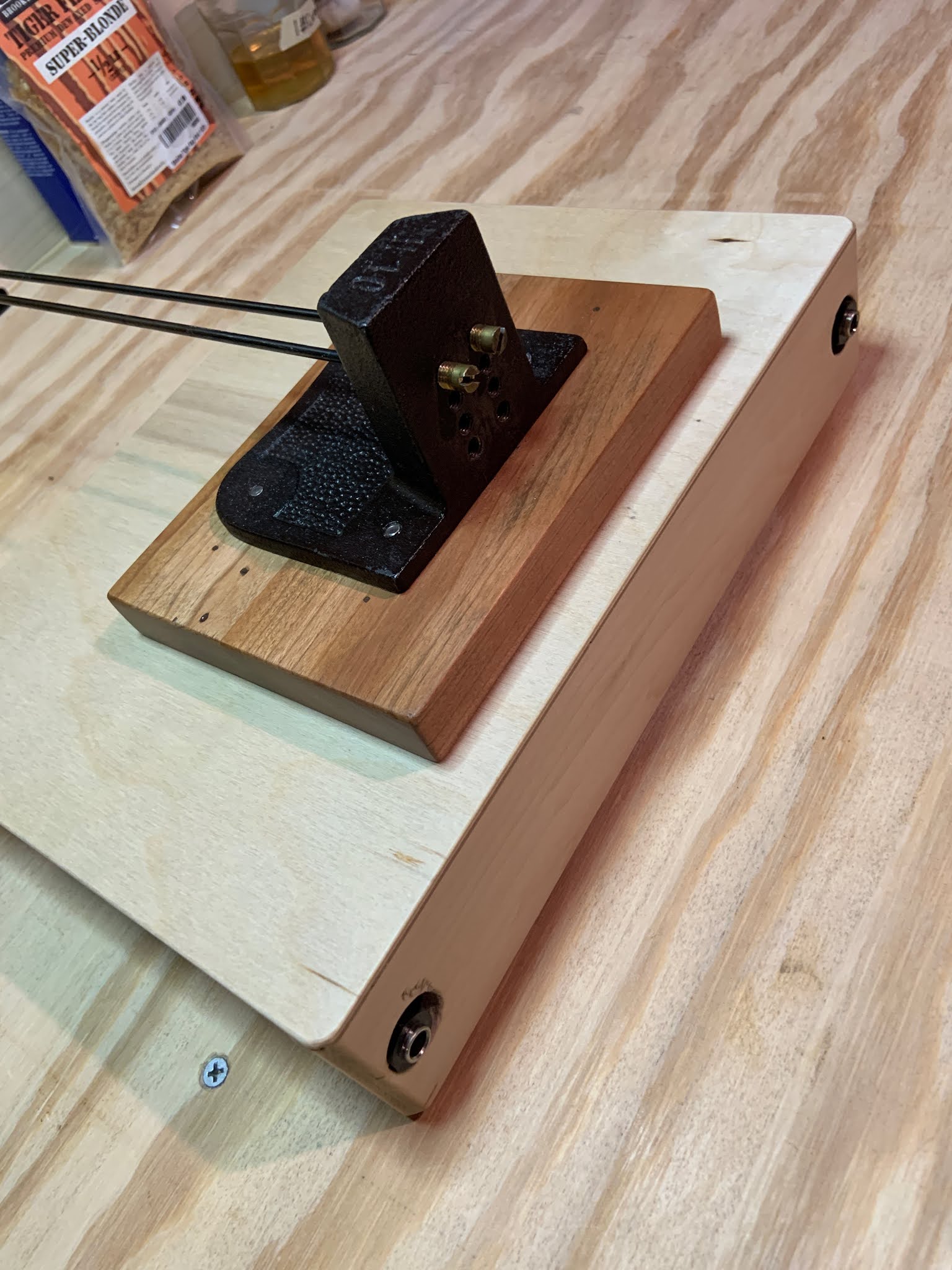
One night last November on my way home from the office, I went by a craft store and picked up one of those wooden project boxes that people paint or decoupage (I wonder what the other customers thought as I sorted through the shelf tapping on and listening to each box one by one).  At home on my family room floor, I spent quite a while experimenting with how to position the chime unit to get the best tone and resonance from the box.  I also expended some effort rehabilitating it, as the bridge was dusty and oily with age; in that process, one of the rod-gongs broke, but, fortunately, it was one of two at that pitch.  All that done, I finally screwed the reassembled unit to its new soundbox and began experimenting with playing it, using an old violin bow I had.  Unfortunately, the rods were nested in such a way that one could only access two at a time with the bow, so I couldn't play any melodies, however simple, but it made a really interesting drone with lots of overtones -- I was pleased.  Trying to mic it for recording tended to interfere with the bowing, so I experimented further with two piezo pads, eventually gluing them in place and attaching their 1/4" sockets to the walls of the soundbox.  I liked the amplified sound and recorded a piece with the instrument, but it seemed musically incomplete and I didn't know where to go with it, so I left it alone.  

Fast forward to this past week, when I found myself with a workshop in which I could actually build and experiment with musical instruments.  One of the explorations I was engaged in was figuring out what kind of finish I wanted to use for the instruments I was going to build.  I'd had quite a bit of experience working with lacquer, some with varnish, and a little with oils and they all had advantages and disadvantages; after much research (read: Internet surfing), I concluded that shellac was a good place to start, but I really hadn't done anything with it before.  I had already started building the kalimba kit, but wanted something to practice on before committing to that, so, after doing some tests on scrap wood, I decided the clock chime needed a finish.  In the end, I was pleased with how it came out, especially the dark wood to which the bridge is mounted, although it's difficult to see in these images the depth it added.  I now consider the instrument -- at least this iteration of it -- complete.  Thus:  

Top and front, with two rod-gongs attached to the bridge and the rest in a simple holder I made.  (I'm not showing the bow here.)

From the back; you can see the brass screws attached to the top of the rods as they are inserted into the bridge.

Close up of the bridge from the front… 

...and from the back.

Placement of the piezo mics and their output; notice they are asymmetrical.  You can also see the screws and washers attaching the wood block to the soundbox.   

As I say, I was pleased with the result, and with myself; I had had an idea for an instrument and had built it, at least a prototype.  Although I didn't think I was the first person to have the idea to bow a rod-gong, I did have the thought that maybe I might have done something fairly original.  

I've since learned that, well, it's unlikely.  

Of course, anyone with an education in twentieth century music can list a handful of pioneering instrument makers -- Harry Partch, the Baschet Brothers, Luigi Russolo, Lou Harrison, among others -- whose inventiveness pushed the boundaries of music, sculpture, and even art.  Unsurprisingly, their work inspired generations of others even more fascinated than me by how sound is created and propagated.  Too, Western musicologists have traveled the world exploring sound arts from folk to classical traditions of non-Western cultures, discovering the inventiveness of millennia of instrument making; the Sachs–Hornbostel system of instrument classification has over 300 basic categories and still doesn't capture everything.  

So, while it's possible -- only possible, I say -- that no one else has bolted a clock chime to a crafts box from Michael's, electrified it with piezos, and played it with a bow, it turns out my instrument fits neatly into a well-established class of sound-making devices.  It's a kind of idiophone, that is, instruments the body of which creates the initial vibrations (as opposed to a string, membrane, column of air, etc.), and of the subclass lamellaphone, where the vibrating body is anchored at one end (it turns out that the kalimba is in the same subclass).  There are examples of bowed lamellaphones, too, such as the nail violin and the daxophone.  

All of this I learned through a recent reading of Bart Hopkin's Musical Instrument Design, a fabulous book on principles of sound making that takes an impressively detailed overview of pretty much any kind of instrument you can imagine -- and a whole bunch you never did.  Mr. Hopkin has been designing and building instruments since the 1980s and knows of what he speaks; you can hear and see some of his work on YouTube.  I didn't know it when I was in high school, but I think what I really wanted then was to be Bart Hopkin.  

At this point in my life and my career(s), I know that's not gonna happen (I mean, it already did, right? -- he's Bart Hopkin!), but, to paraphrase what I said in my previous post, it doesn't matter whether I change the world, just that what I'm doing is meaningful.  I had a blast building and experimenting with my bowed clock chime and it has given me ideas for other sounds and music I want to make.  I plan on exploring those ideas when and as the chance takes me.  

How I Spent My Summer Vacation

The first day of my vacation, I woke up.  Then, I went downtown to look for a job.  Then, I hung out in front of the drug store.  The second day of my summer vacation, I woke up.  Then, I went downtown to look for a job.  Then, I hung out in front of the drug store.  The third day of my summer vacation, I woke up.  Then, I went downtown to look for a job.  Then I got a job keeping people from hanging out in front of the drug store... 

-- Cheech & Chong, "Sister Mary Elephant" from the album Big Bambu

I've had a desire to build musical instruments since at least high school, when, in my sophomore or junior year, I came across a book called The Physics of Music, a paperback binding of some Scientific American articles on the subject.  Simultaneous with its fomenting effect, the book also told me I couldn't possibly build instruments, as the pages were interspersed with mysterious squiggly mathematical symbols that supposedly meant important things to anyone smart enough to build musical instruments (I was one of those kids who believed I sucked at math).  Four or five years later, I found myself working for a piano restorer, eventually learning to rebuild player pianos, but even then I believed I didn't have what it took to be a "real" piano technician because I hadn't learned to tune pianos -- something that, again, at the time seemed utterly esoteric.  

In the four decades since my first thrill at the thought of making instruments, I've discovered that most of what I believed about my shortcomings was bullshit -- I'm decent at math and I can train my ear to hear anything below the range of my tinnitus -- and, perhaps more importantly, have come to believe that if you want to do a thing, you should just do it.*  Whether you're good at it or not doesn't really matter if it's meaningful to you.  

Still, even with that understanding, circumstances have been such that instrument making hasn't been logistically feasible for me -- until very recently.  As a result of a surprise largesse earlier this year, my wife and I decided to make some significant quality-of-life investments in our home:  we built a garden for her and a basement workshop for me.  Suddenly and unexpectedly, the dream of instrument building has become a reality!

In early July, I made plans to take the first full week in August off from my practice.  I'd spent my spare time since June building workbenches and my wife and I had organized the basement (she did the lion's share of that).  For Father's Day, I received an excellent book on musical instrument design.  Serendipitously, a musical instrument kit company I like had a sale, so I picked up a couple of kits.  By the time I started vacation, everything was set up and I could spend the week futzing about the workshop, making sawdust, gluing chunks of wood together, and getting shellac all over my fingers.  Pure joy.  

My efforts produced two objets de musique:  first, a bowed clock chime (my own design) and, second, a kalimba (the first of the two kits).  I'll write about those in more detail in separate posts (see links).  Also arising from this recent burst of inspiration was a piece composed for and performed on those instruments; I'll post about that separately, too.  

My fantasy has reified into fact.  I have ideas for several instruments in the queue:  a bowed psaltery (the second kit), a multistringed monochord (a zither-like instrument with many strings all tuned to the same pitch), a single-string, very long monochord (like 10 or 15 feet), aeolian harps of various sizes and design, didgeridoos, a very large spring reverb (like 10 feet -- technically not an instrument but an audio effect), and others.  Over the balance of my life, I hope to build many instruments, to make music with them, and, with luck, to share them with the local music community.  However the project goes, I'll be posting updates and developments here.  


*Within the limits of harm, of course.